Fabrics
- crochet
- suede
- washed cotton
- linen gauze
- corduroy
- embroidered cotton
→ 01 / Women
Free-spirited and earthy
Flowing fabrics, earthy tones, prints and layered accessories — a relaxed, artistic style with a 70s soul.
The short answer
Boho style for women is flowing shapes in earth tones with texture doing the decorating: a tiered maxi dress or high-rise flares, an embroidered blouse, suede, crochet and stacked brass. It reads free, but it only works with one defined waist somewhere in the outfit and a palette that stays inside three warm tones.
Nothing should hold its shape when you walk. One defined waist, everything else moves.
Updated September 22, 2026
→ 02 / What defines it
→ 03 / Where it comes from
The word arrived before the clothes did. Nineteenth-century Paris borrowed “bohémien” for its poor artists and writers, who dressed in secondhand and imported oddments because that was what they could afford, and the association between creative life and mismatched clothing stuck. The wardrobe itself was assembled a century later on the overland hippie trail, when young travelers came back through Europe with Afghan sheepskin coats, Indian block-printed cotton, Moroccan embroidery and Rajasthani mirrorwork, and wore them with American denim. Biba and the Portobello stalls sold the result back to London; the mid-2000s festival circuit revived it; the 2020s brought it round again. Every version shares one mechanism that most copies miss. Boho was always accumulated, never bought as a set, and the clothes were expected to fade, stretch and soften into you. That is why a head-to-toe new boho outfit looks wrong in a way a new suit does not.
→ 04 / Boho outfit ideas
Year-round
Why it works: Flares and a soft blouse give you movement at both ends. The belt is what keeps all that volume from reading as pajamas — boho needs a waist somewhere, and this is the cheapest place to put one.
Warm
Why it works: One long dress handles the whole silhouette, so the styling budget goes entirely into accessories. Three bangles that knock together when you move is the detail; a matching jewelry set is the opposite of it.
Warm
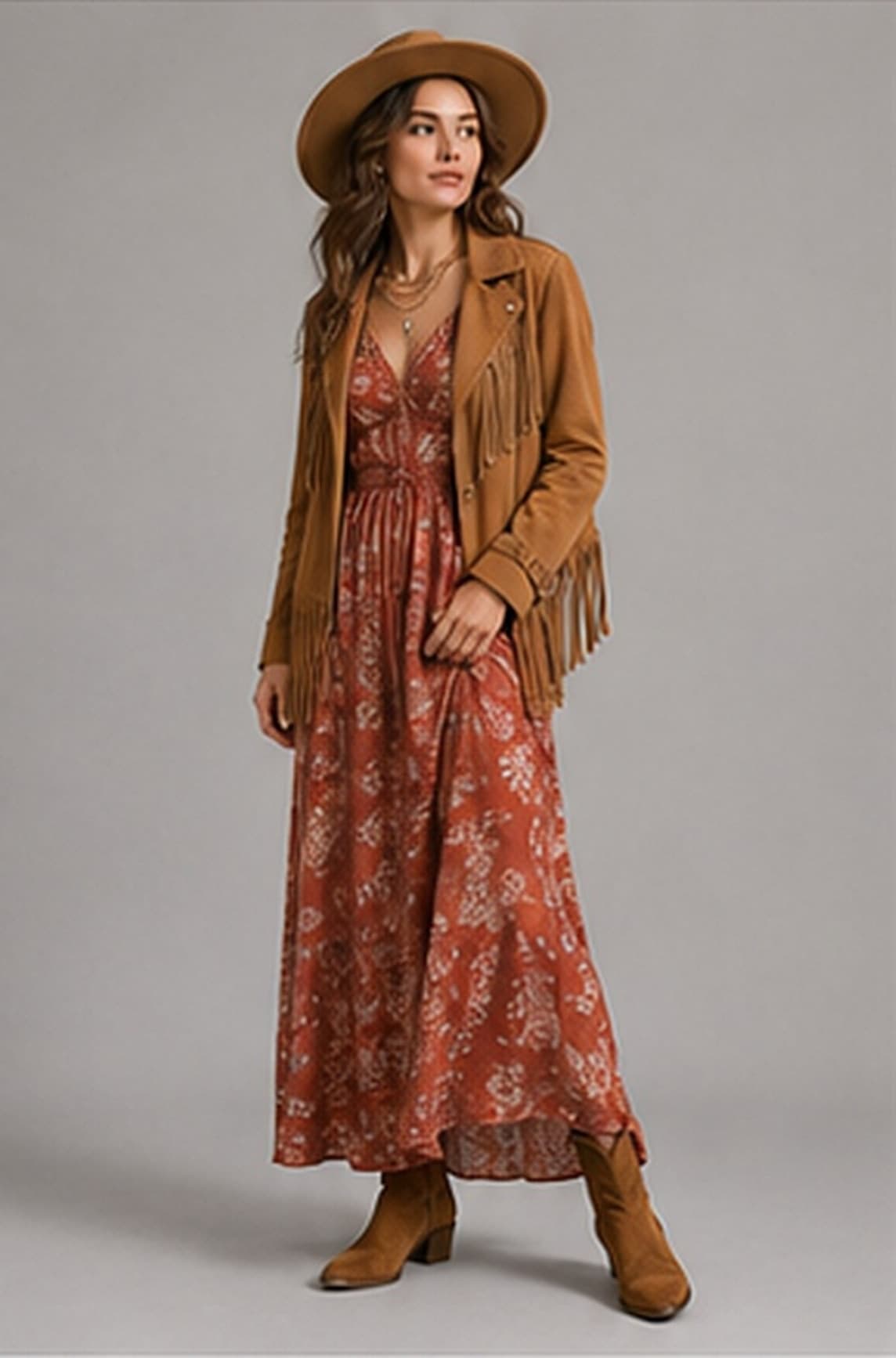
Why it works: The only formula here that layers something heavy over something bare. Boots instead of sandals because the ground is never as clean as the photographs suggest, and the brim is sun protection before it is styling.
Cool
Why it works: The cardigan is boho's blazer: it adds warmth and weight without straightening a single line. Let the pendant drop below the dress neckline so the eye reads one long vertical instead of two competing ones.
Cold
Why it works: Winter boho runs on texture rather than print. Corduroy, cable, shearling and wool stacked in one outfit, all held inside the same two or three earth tones, so the surfaces do the work the pattern usually does.
Year-round
Why it works: Silk instead of cotton is how this style dresses up, and it never involves sequins. Keeping the heel on a boot rather than a sandal is what lets the outfit hold its slouch while still looking like an evening decision.
→ 05 / Outfit examples
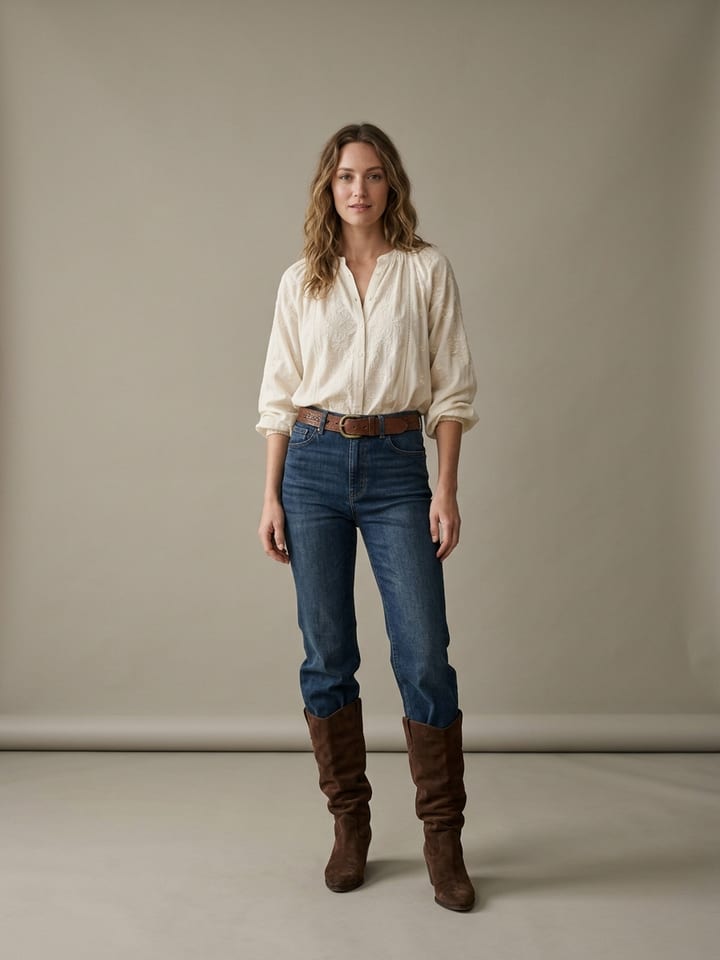
Flared jeans, an embroidered blouse and tall suede boots.
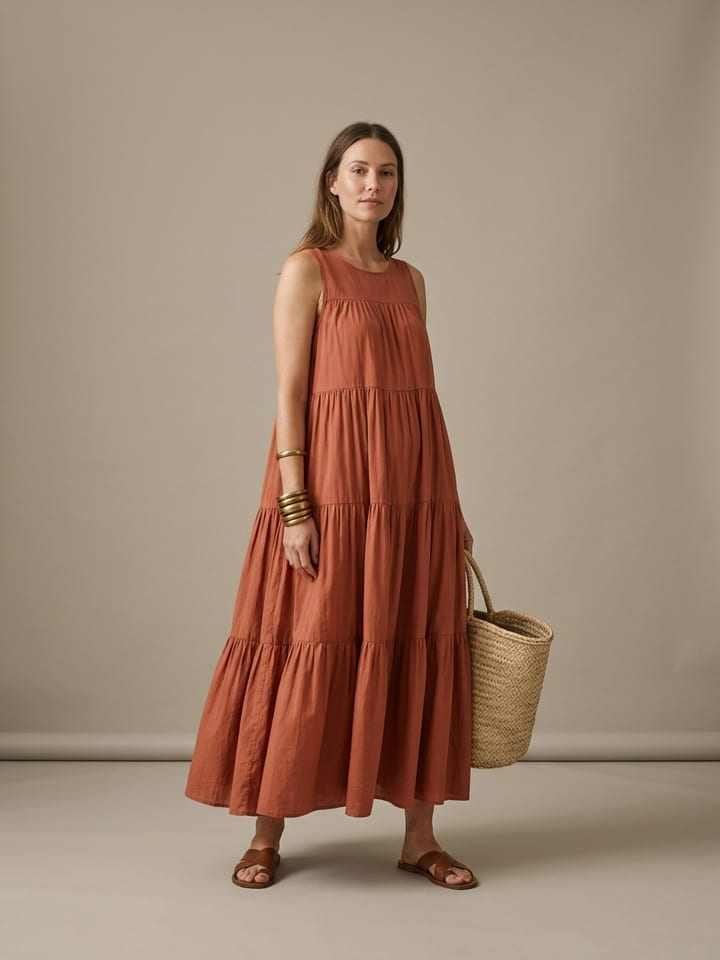
A tiered cotton maxi dress with flat sandals and a straw tote.
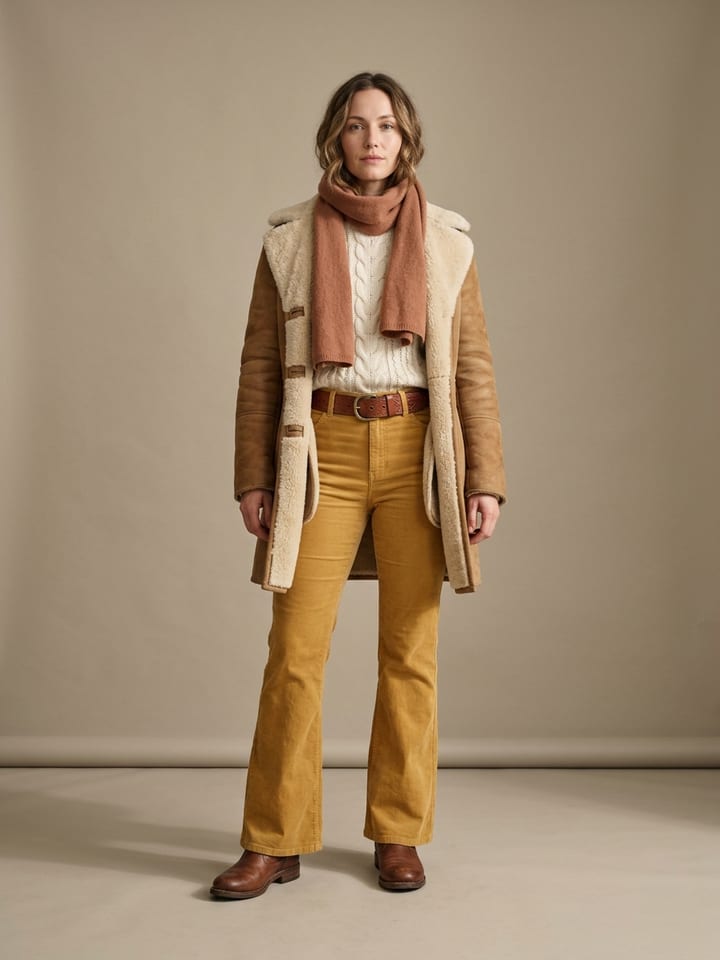
Corduroy flares and a cable knit under a shearling coat.
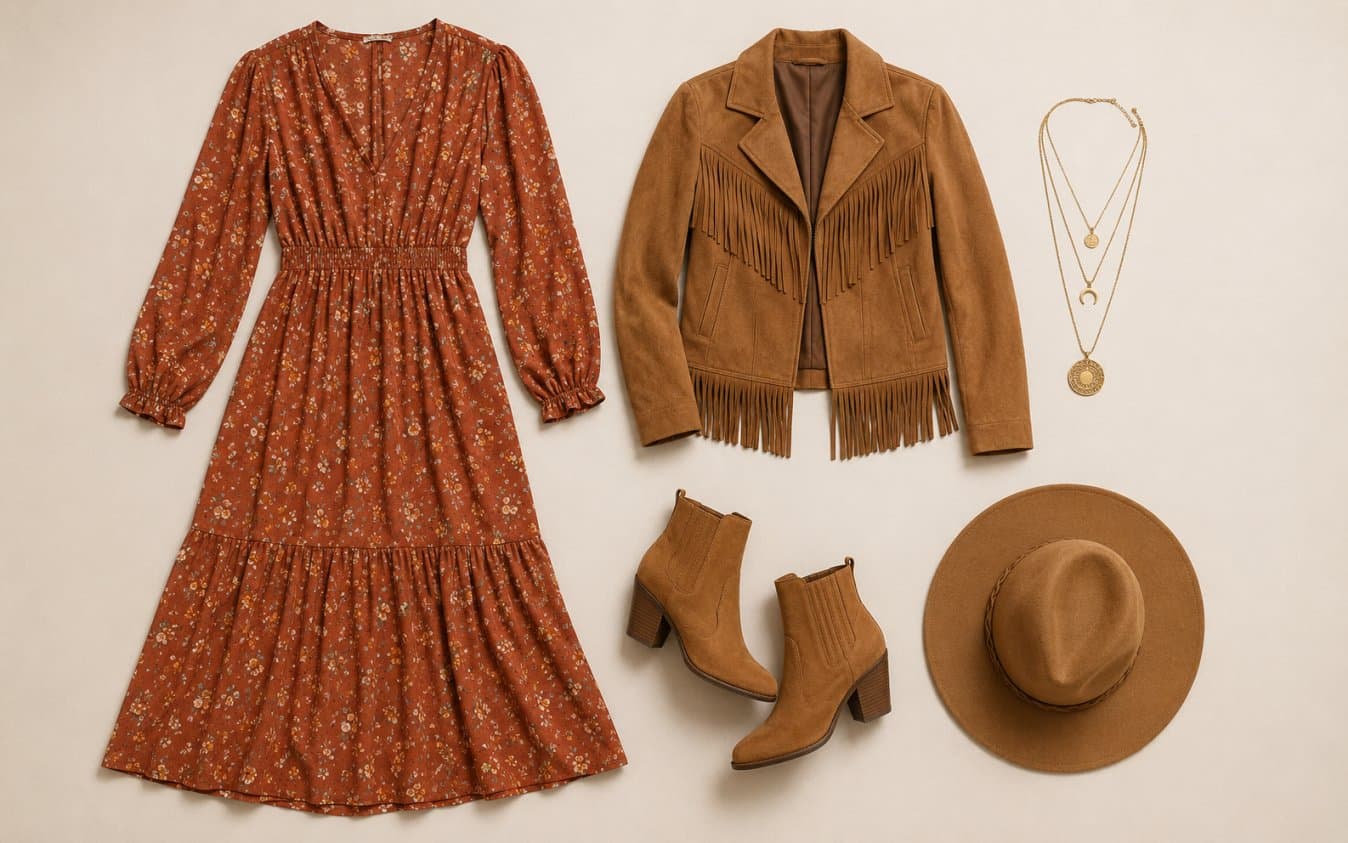
→ 06 / Key pieces · Women
→ 07 / Starter capsule
→ 08 / Palette & fabrics
Cold greys, neon and any mirror finish. Boho colors should look like they came out of a dye pot — if a shade is precise enough to sound engineered, it is fighting the style. Slippery polyester is the other killer: it drapes flat instead of falling, and it shines in daylight.
→ 09 / Across the seasons
Printed midi dresses and the cardigan, with boots still on. Spring boho is the summer wardrobe with something over the top of it.
Cotton and gauze, maxi length, flat sandals. The one season where bare shoulders are fine — everything else in the style is about covering up loosely.
Peak boho. Suede, corduroy, embroidery and long sleeves in terracotta and mustard, which is exactly the palette the season hands you for free.
Swap print for texture and keep the hem long. A shearling or suede coat over a maxi does more than a shorter coat and a heavier knit.
→ 10 / Where it goes wrong
The festival costume. A feathered headband, a mirrored coin belt, five prints and a tapestry bag at once reads as fancy dress rather than a wardrobe.
Instead: One statement per outfit: the print, or the fringe, or the hat. Everything else stays plain and inside your earth tones.
Volume with no waist. A loose blouse over wide flares with nothing defined in between hides your whole frame and adds width exactly where you don't want it.
Instead: Belt it, tuck it, or keep one piece loose and the other close. Boho is flowy, not shapeless — those are different outfits.
Cultural symbols worn as decoration. Sacred motifs, ceremonial headdresses and religious imagery pulled in for texture is the oldest problem with this style.
Instead: Buy craft, not costume. Handwoven, embroidered and block-printed pieces sold as clothing by the people who make them — the technique is what you actually want, not the symbol.
Brand-new everything. A boho outfit bought in one order has no patina at all, and this is the one style where patina is most of the appeal.
Instead: Let one piece be genuinely old — the jacket, the belt, the jewelry. Suede and leather do the aging for you if you give them a couple of years.
→ 11 / How to start this week
→ 12 / Style icons, and what they actually wore
Mid-2000s Portobello: a coin belt over a peasant dress, a shrunken waistcoat and flat boots. She is the reason boho has a mainstream template — and also the reason it spent a decade over-accessorized.
Layered chiffon, a shawl with fringe long enough to move on its own, platform boots, and mostly black. Proof the style is about drape and layering, not about earth tones.
Full-length vintage lace and embroidered capes worn in ordinary daylight. The maximalist end of boho, held together only by keeping every layer in the same tone.
→ 13 / This might be you if...
→ 14 / Often confused with
→ 15 / Mixes well with
→ 16 / FAQ
Boho style for women is free-spirited and earthy: flowy silhouettes, prints, and layered accessories with a 70s soul. Maxi dresses, embroidery, and a wide-brim hat do more than a tight mini.
Do choose movement: a maxi, an embroidered blouse, flared jeans. Do mix textures — crochet, suede, fringe. Do layer jewelry and a hat without turning it into a costume.
Don’t make it a festival caricature of coins and headbands unless that is the brief. Don’t use stiff corporate tailoring as the base. Don’t pick shiny synthetic “boho” prints that feel like costume shop.
Women can wear Boho style to markets, weekends, travel, creative work, and warm-weather days. Tone it down for conservative offices; skip it for black-tie.
Typical colors are rust, cream, mustard, terracotta, and brown, in linen, suede, crochet, and washed cotton. Women’s boho palettes should look sun-faded, not neon.
A common Boho mistake for women is wearing every tribal-inspired trend at once, or pairing a maxi with stilettos that fight the ease. Ground it with boots or sandals.
Two minutes of swiping tells you whether Boho is genuinely your Style DNA — or a holiday wardrobe you love for two weeks a year.
Take the style quizYou are cordially invited
Modesona is your personal stylist — free, instant, and built around everything already hanging in your wardrobe.


Free · No card required · iOS & Android