Fabrics
- brushed cotton flannel
- washed denim
- soft cotton jersey
- chunky wool knit
- worn leather
- satin
→ 01 / Women
90s Seattle, still loud
Flannel, rips and worn-out boots — the 90s anti-fashion uniform that made not trying the whole point.
The short answer
Grunge style for women is a faded band tee, ripped straight or mom jeans, an oversized plaid flannel and heavy boots — with a slip dress layered over a tee when you want the softer 90s version. The whole thing runs on contrast: something delicate against something heavy, and nothing that looks like it was bought this week.
If it isn’t faded, soft or a size too big, it isn’t there yet.
Updated September 22, 2026
→ 02 / What defines it
→ 03 / Where it comes from
Grunge came out of the Pacific Northwest music scene in the late 1980s, and almost none of it was a fashion decision. Flannel was cheap at the thrift store, warm in an unheated practice space and already worn soft by somebody else; jeans ripped because they were worn daily for years, not because a factory sanded them. When the Seattle bands broke nationally at the start of the 1990s, the clothes traveled with the music and the industry tried to sell the look back at luxury prices — Marc Jacobs’ grunge-inspired collection for Perry Ellis, shown in 1992, is the famous example, and it reportedly cost him the job. That contradiction is still the useful part. Grunge is the one style where money is a liability: the pieces have to look accumulated, secondhand and slightly wrong together, because the original wardrobe was assembled by people who weren’t shopping.
→ 04 / Grunge outfit ideas
Year-round
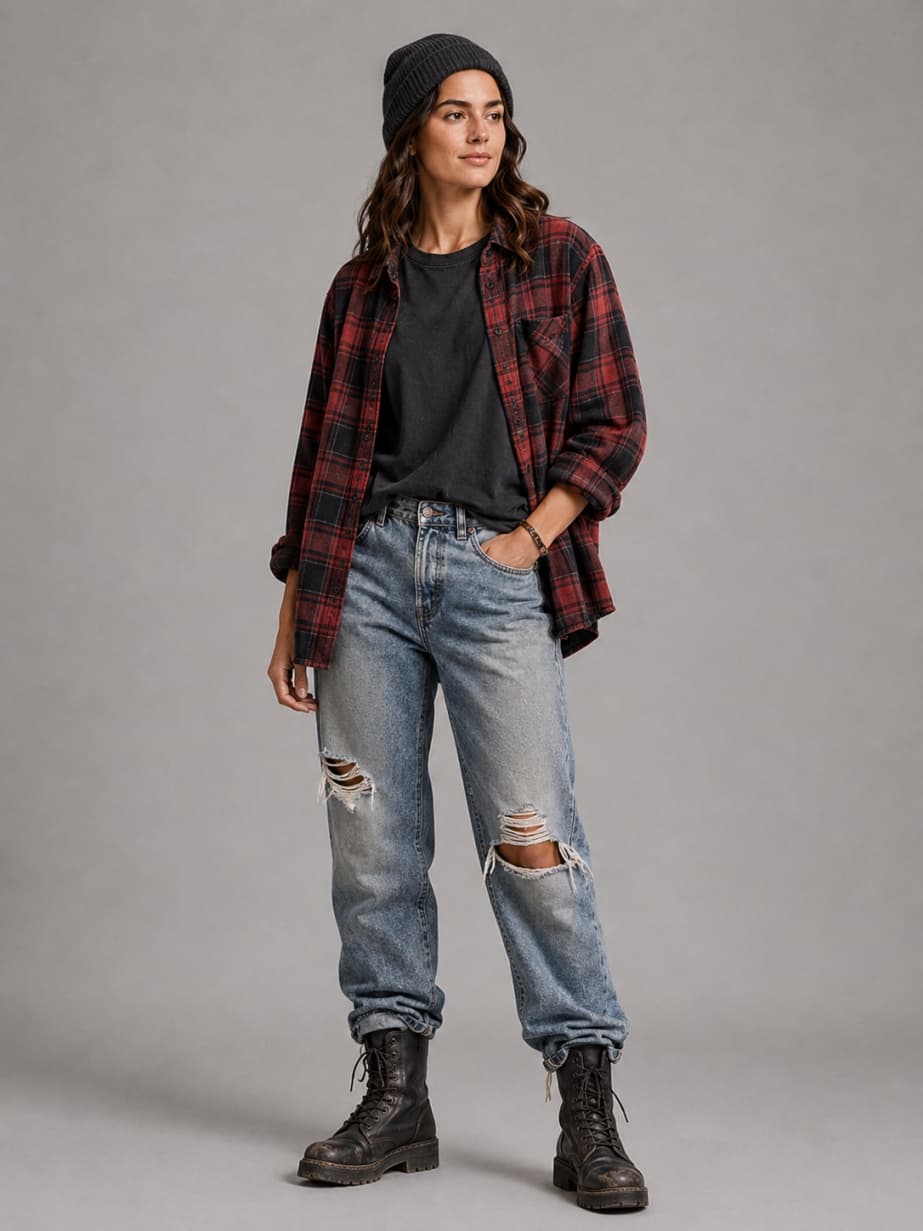
Why it works: The base every other grunge outfit edits. The flannel hangs open and unbuttoned so it reads as something you grabbed, and the heavy boot under a soft jersey tee is the contrast the whole style is built on.
Cool
Why it works: The tee under the slip is the entire trick — it takes the lingerie out of the dress and turns it into daywear. Boots stop the satin from floating off into romantic territory.
Cold
Why it works: Leather instead of flannel is how grunge gets louder without getting smarter. Keep the tee faded — a crisp new band shirt is the single fastest way to look like you’re in costume.
Warm
Why it works: Grunge in heat survives by moving the flannel rather than dropping it: tied at the waist it still does the layering job and breaks up the leg line. Cut-offs should be uneven, not hemmed.
Year-round
Why it works: Trade the plaid for a dark knit and the rips for solid black and the attitude survives the dress code. This is grunge’s quietest register, and the one it can actually hold five days a week.
Cool
Why it works: Two thin layers under nothing waterproof is exactly how the original wardrobe worked in a wet climate. The striped tee under plaid is the pattern clash the style has always permitted.
→ 05 / Outfit examples
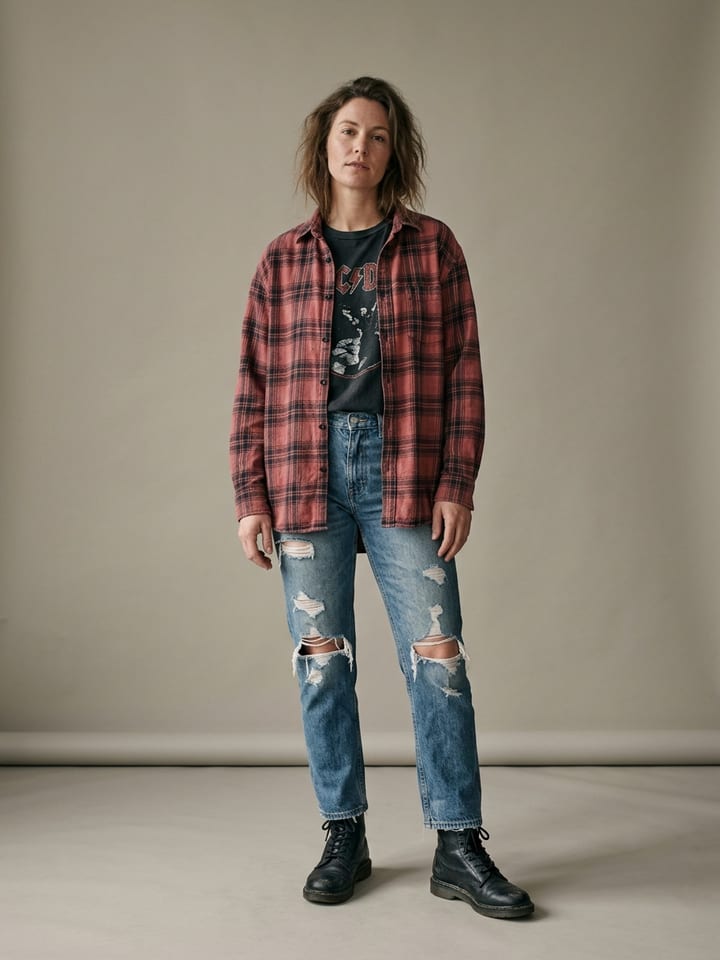
Ripped jeans, a faded band tee and an open plaid flannel.
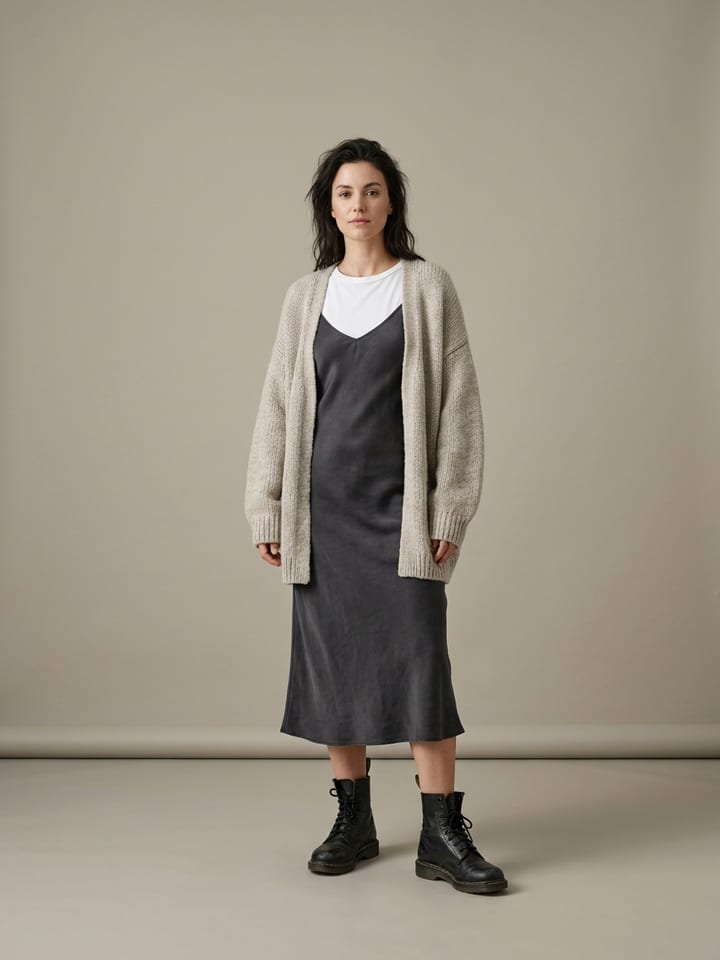
A satin slip over a white tee, with a slouchy cardigan.
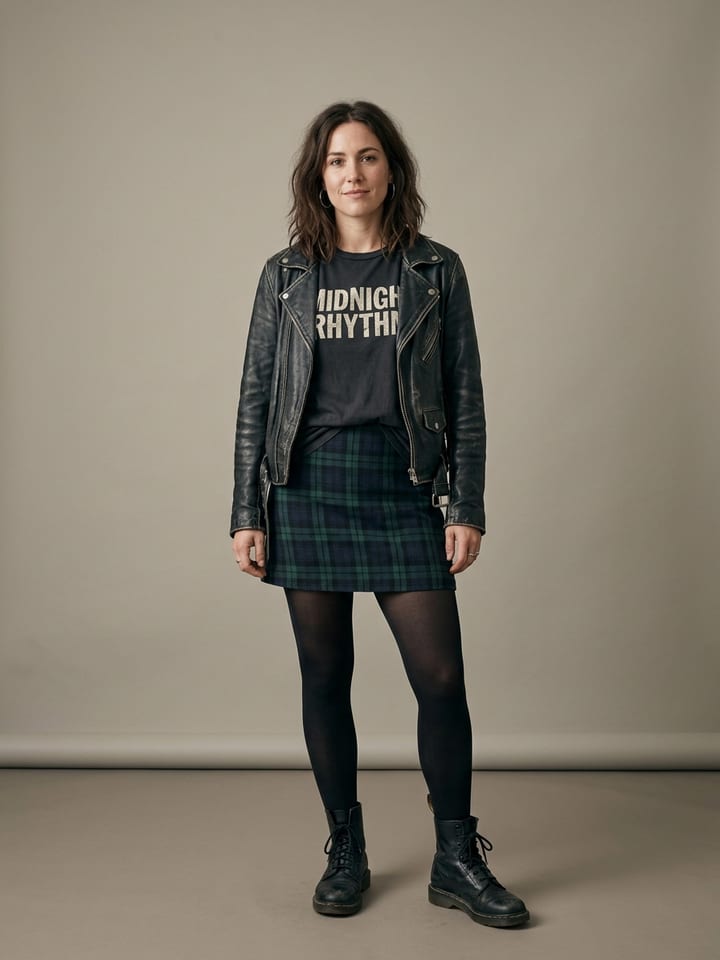
Band tee, plaid mini and a beaten leather moto jacket.
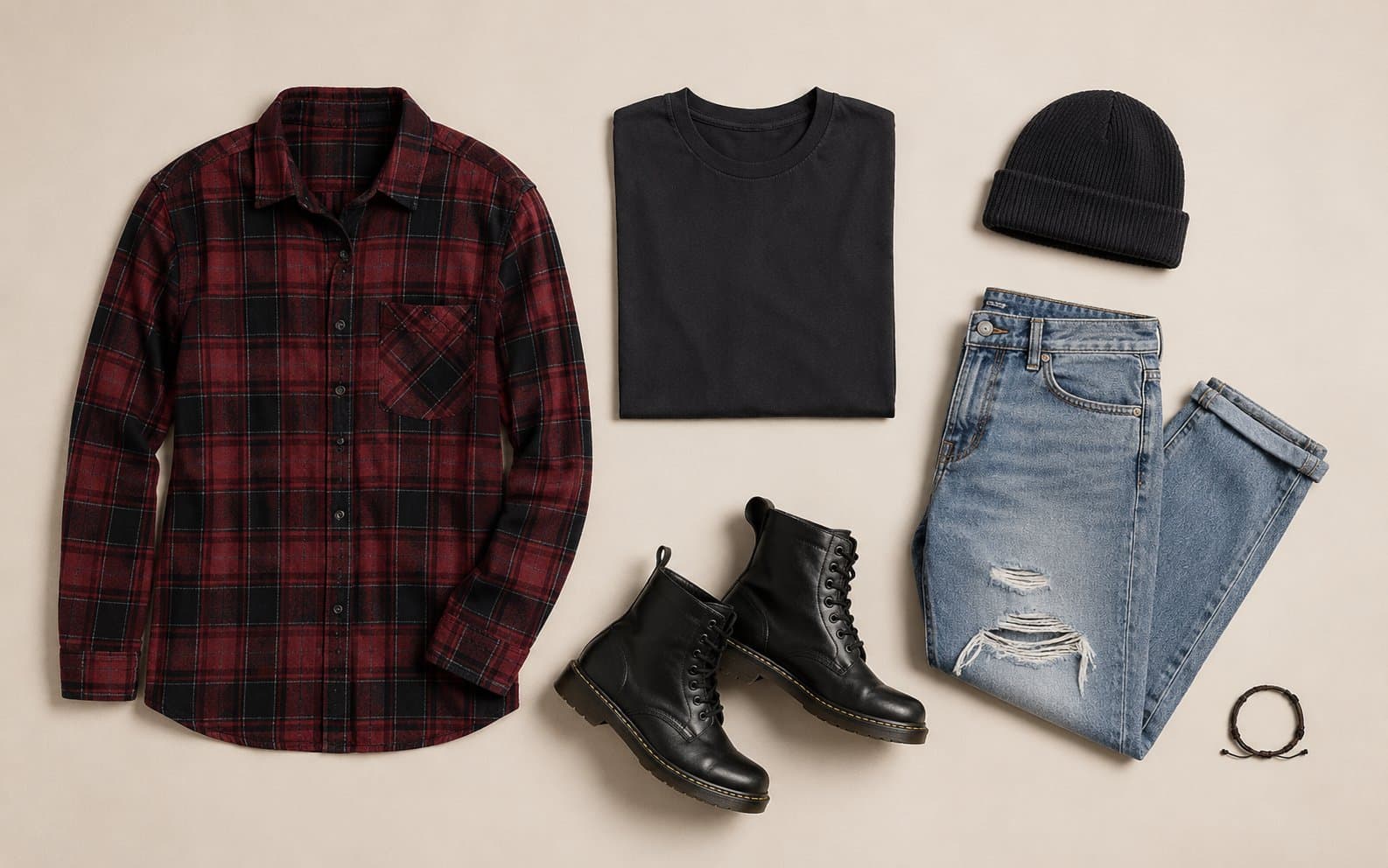
→ 06 / Key pieces · Women
→ 07 / Starter capsule
→ 08 / Palette & fabrics
Anything at full saturation. Grunge colors are colors that have been through a hundred washes, so neons, clean pastels and true optic white all read wrong. Pre-matched plaid sets and anything with a crisp screen print break it just as fast as the color does.
→ 09 / Across the seasons
Flannel over a tee and nothing else on top. Lose the beanie, keep the boots, and let the jeans do the rest.
Cut-offs or a slip dress with the flannel tied at the waist. Grunge sweats in summer and that is historically accurate — just avoid sandals entirely.
The home season. Flannel, cardigan, boots and a jacket layered in whatever order you grabbed them in that morning.
Thermal under the tee, cardigan over it, and an army-surplus parka or moto jacket on top. Bulk is welcome here in a way it isn’t in any other style.
→ 10 / Where it goes wrong
Buying the distressing. Factory rips in symmetrical places, with the whiskering printed on, look exactly like what they are.
Instead: Buy secondhand denim that already failed somewhere real, or buy plain jeans and give them two years. Rips at the knee and the back pocket happen; rips across the thigh in a neat row do not.
The complete outfit, bought in one order. Matching plaid, new boots and a band tee for a band you can’t name is a Halloween costume with a long receipt.
Instead: Mix sources. One thrifted flannel, jeans you already own, and boots you wear until they crease unevenly — that is the whole look.
Oversized on oversized on oversized. A baggy tee under a huge flannel over wide jeans loses the body entirely and just looks like fabric.
Instead: Keep one layer close to the body — a fitted tee, a slip, or a tucked front hem — and let everything else swallow you.
Pristine boots. Grunge footwear that still has a shiny toe box and a white sole cancels every other piece in the outfit.
Instead: Wear one pair into the ground rather than owning three clean ones. Scuffs on the toe are the point; falling-apart soles are not — resole them.
→ 11 / How to start this week
→ 12 / Style icons, and what they actually wore
Torn baby-doll dresses with smeared red lipstick, chipped nails and heavy boots. She built the ruined-feminine half of grunge, and it is the half most people copy without realizing where it came from.
Black slip dress, oversized cardigan, flat boots and short dark hair, on and off screen through the early 90s. The proof that grunge works without a single piece of plaid.
Men’s tees, loose jeans and a jacket that fit nobody in particular, worn flat and unstyled. The version of grunge that predates the trend and never once looked like marketing.
→ 13 / This might be you if...
→ 14 / Often confused with
→ 15 / Mixes well with
→ 16 / FAQ
Grunge for women is 90s anti-fashion: flannel, rips, lived-in tees, combat boots, and layering that looks thrifted on purpose.
Do wear an oversized flannel open, a faded band tee, ripped jeans or a slip over a tee, and combat boots. Do let things look worn. Do keep the palette dirty — black, plaid, army green.
Don’t polish it into glam. Don’t buy brand-new “destroyed” jeans with a matching fancy bag. Don’t mix in old-money cashmere as the base.
Women can wear Grunge to gigs, weekends, creative work, and city nights. A full slip-and-combat look may need toning down for conservative offices.
Typical colors are black, faded plaid, grey, and army green, in flannel, distressed denim, and worn leather. Women’s grunge palettes should not look freshly dyed.
A common Grunge mistake for women is pretty-grunge costume: perfect makeup, unworn boots, and a $400 “thrift” flannel with the brand still shouting. Wear it in.
Two minutes of swiping tells you whether Grunge is actually your Style DNA — or a mood you borrow when everything else feels too polished.
Take the style quizYou are cordially invited
Modesona is your personal stylist — free, instant, and built around everything already hanging in your wardrobe.


Free · No card required · iOS & Android