Fabrics
- fine-gauge merino and cashmere
- silk and satin-finish shirting
- washed linen
- pointelle and cable knit
- soft leather
→ 01 / Men
Bows on everything
Hyper-feminine and a little theatrical — ribbons, lace, pearls and blush tones that turn softness into a statement.
The short answer
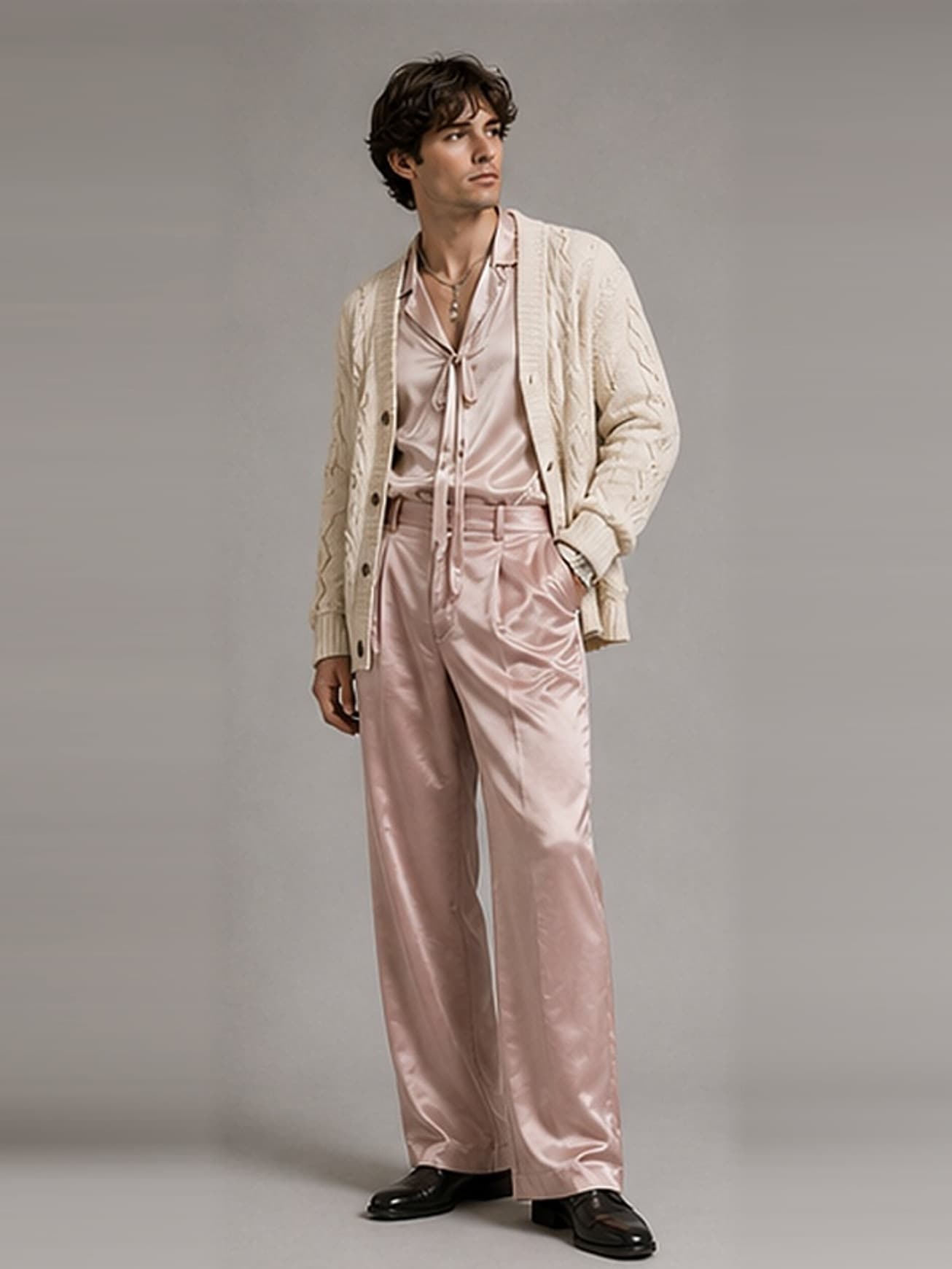
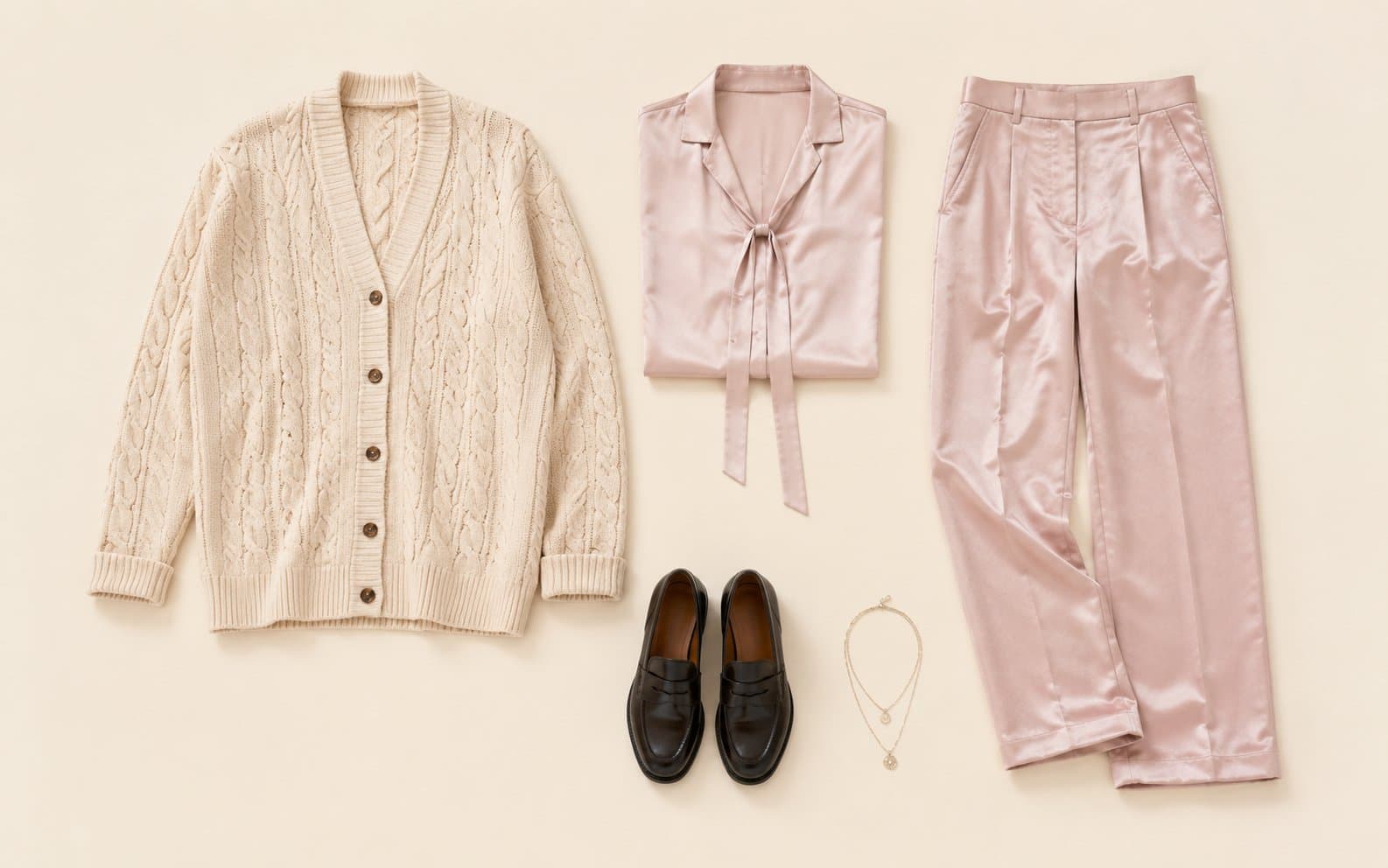
Coquette for men is soft material and soft color inside conventional menswear shapes: a pastel fine-gauge knit, a satin-finish shirt, relaxed pleated trousers, loafers, and one pearl strand or fine chain. It isn’t a costume and it isn’t a borrowed wardrobe — it’s the dandy tradition, where men wore lace, silk and jewelry as a matter of course, translated into clothes you can wear to dinner.
Every soft outfit needs one hard edge, or the sweetness stops reading as a choice.
Updated September 22, 2026
→ 02 / What defines it
→ 03 / Where it comes from
Coquette comes from the French for a flirt — a diminutive of coq, rooster, for someone who struts. The visual vocabulary predates the internet by centuries: the ribbons, pastel silks and bows belong to eighteenth-century Rococo dress, and specifically to the version associated with Marie Antoinette’s retreat at the Petit Trianon, where court formality was traded for muslin, lace and staged simplicity. Sofia Coppola’s Marie Antoinette put that exact palette back into circulation in 2006, modern sneakers left visible in the frame and all. The current revival grew out of 2010s Tumblr — an aesthetic built on nostalgia for girlhood that was not always healthy about it — and was then rebuilt on short video around ballet flats, hair ribbons and designers leaning hard on the bow. What carried over from every earlier version is the self-awareness. Coquette knows it is performing femininity, and the performance is the entire point.
→ 04 / Coquette outfit ideas
Year-round
Why it works: Nothing here is unusual except the color and the hand of the knit, and that is the entire strategy: familiar shapes, softer materials, and the palette doing the talking.
Cool
Why it works: A single strand of pearls over an open collar has a long menswear history and it reads considered rather than borrowed. Keep the rest of the outfit strict and dark so it stays the only soft note.
Warm
Why it works: Tonal pale-on-pale in natural fabric is the most wearable version of this, because the softness comes from the palette rather than from any single conspicuous piece.
Cold
Why it works: A cardigan in place of a blazer is the softest structural swap in menswear, and a heavy cable holds its shape well enough that nothing ends up looking slouchy.
Year-round
Why it works: A pale suit is the most straightforward way to do this at a wedding. Unstructured rather than sharp, and no tie — the softness has to reach the shoulder or the outfit argues with itself.
Year-round
Why it works: The same balance the women’s version needs: one tough element stops soft color from reading as fragile. Denim and a real boot are the easiest counterweights to reach for.
→ 05 / Outfit examples
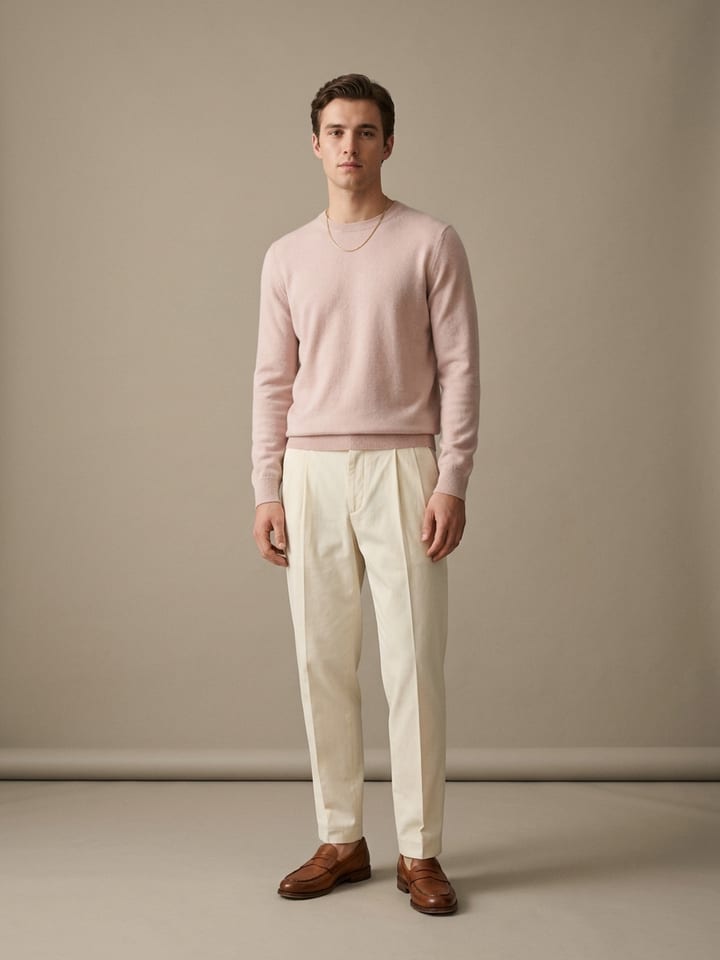
A pale pink fine knit with pleated trousers and loafers.
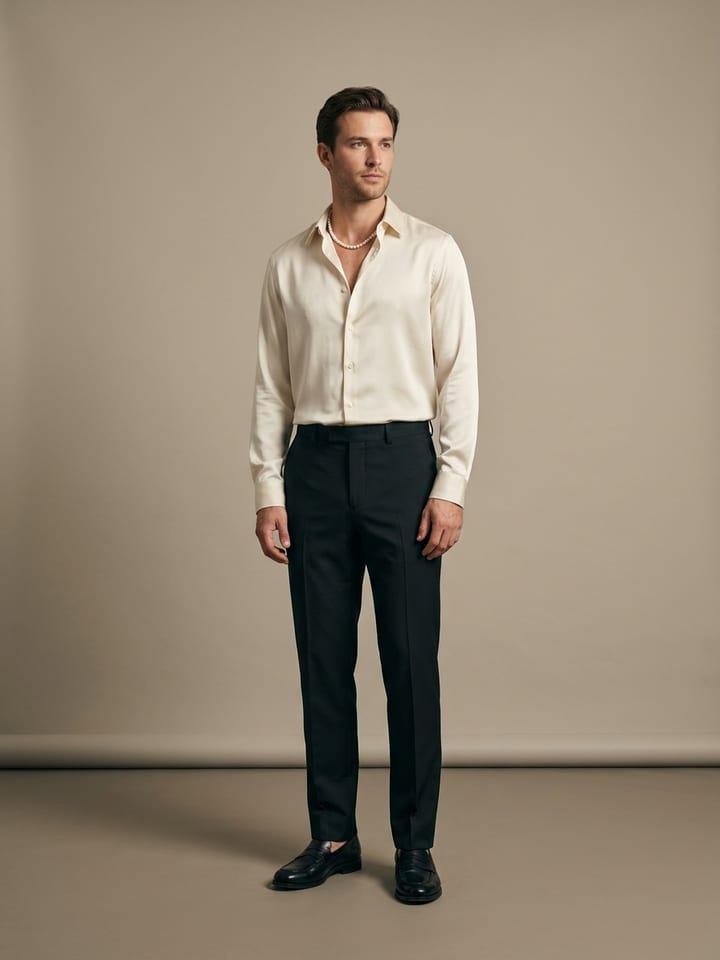
A cream satin-finish shirt with a short strand of pearls.
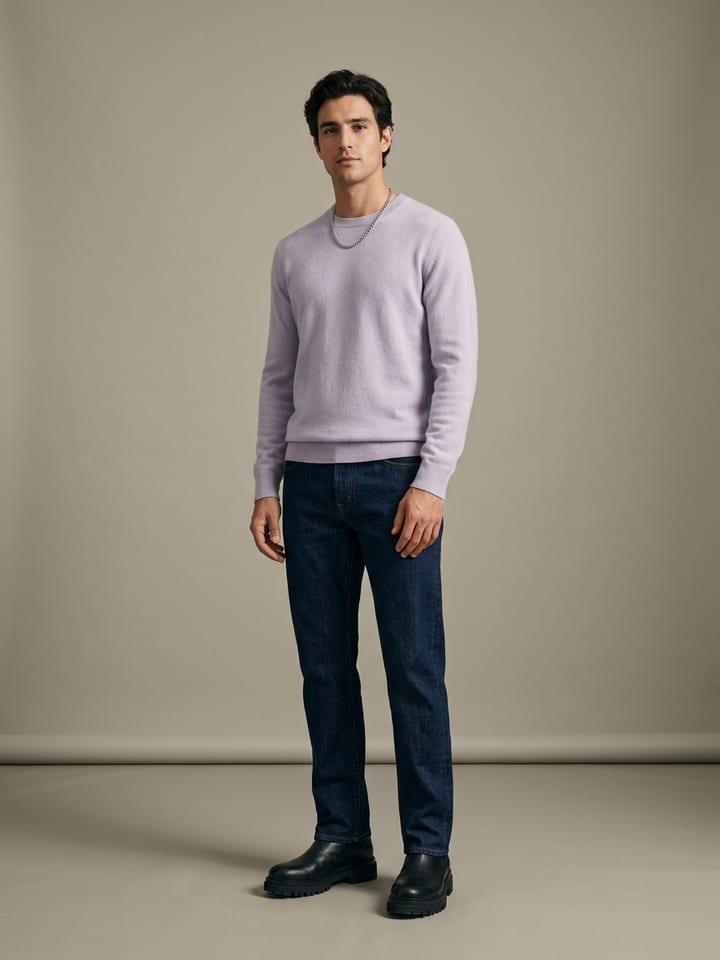
A pastel knit with dark denim and heavy boots.
→ 06 / Key pieces · Men
→ 07 / Starter capsule
→ 08 / Palette & fabrics
Hard black from head to toe kills the palette and takes the style with it. Avoid technical or logo-heavy pieces too — a nylon shell or a sports logo next to a satin shirt reads as a man hedging. Novelty pink is the last trap: hot, saturated or printed, it turns the outfit into a joke, where a muted pink just reads as tailoring.
→ 09 / Across the seasons
The obvious season. Pale knits, cotton shirts, loafers without socks — the palette finally matches the light.
Linen in cream, pink and pale blue, cut loose. Skip satin in heat; it doesn’t breathe and it shows everything.
Heavier knits in the same colors, worn against grey and chocolate. The palette warms up without going dark.
A cream or camel overcoat over pale layers. Defaulting to all-black for the season is how men lose this style entirely.
→ 10 / Where it goes wrong
Taking the reference literally. A hair bow and a ruffled blouse on a man is a costume, and it usually lands as a punchline rather than a style.
Instead: Keep menswear shapes and change the materials and colors inside them. The softness belongs in the knit, the satin and the palette.
One pastel piece dropped into an otherwise unchanged wardrobe. A pink sweater over a gym hoodie with technical sneakers just looks like an accident.
Instead: Commit the whole outfit to the register: soft knit, proper trousers, leather shoes. Consistency is what makes it look chosen.
Jewelry worn half-committed. A pearl strand tucked under a buttoned collar is neither one thing nor the other.
Instead: Open the collar and let it sit visible, or leave it at home. One piece, worn properly — this is the detail the whole look gets judged on.
Cheap satin shirting. Thin polyester with a high shine looks like nightwear, and it is the most common failure in men’s soft dressing.
Instead: Silk blends, heavy viscose or a matte satin. The fabric should hang from the shoulder rather than cling to it.
→ 11 / How to start this week
→ 12 / Style icons, and what they actually wore
Lace cuffs, ruffled shirts, heeled boots and pastel suiting, worn with total conviction for decades. The strongest argument that soft materials read as confidence rather than the opposite.
Pearl necklaces over open collars, pastel knitwear and loose tailoring, on stage and off. The reason a single strand of pearls now reads as menswear rather than something borrowed.
Pastel knits, pearls, painted nails and cropped tailoring, mixed into the streetwear he was already wearing. Proof the soft register can sit inside an existing personal style instead of replacing it.
→ 13 / This might be you if...
→ 15 / Mixes well with
→ 16 / FAQ
Coquette for men is the soft, self-aware register: a pastel knit, a satin-touch shirt, relaxed pleats, loafers, and maybe one pearl or delicate chain.
Do keep the palette blush-adjacent. Do pick one pretty surface — satin, a pearl, a soft knit. Do keep tailoring relaxed, not bodycon.
Don’t costume it with a full ribbon corset unless that is the night. Don’t mix it with gorp shells. Don’t treat it as a joke overlay on a sports jersey.
Men can wear Coquette cues at parties, dinners, and creative nights. A pastel knit still works by day; tulle does not belong in most offices.
Typical colors for men’s Coquette style are blush, cream, and white, in satin, fine knit, and light cotton. Softness is the signal.
A common Coquette mistake for men is irony overload — a single cheap pearl on an otherwise sporty outfit — or wearing so much satin it looks like a costume brief.
Two minutes of swiping tells you whether Coquette is genuinely your Style DNA — or one soft note you like adding to something sharper.
Take the style quizYou are cordially invited
Modesona is your personal stylist — free, instant, and built around everything already hanging in your wardrobe.


Free · No card required · iOS & Android