Fabrics
- worsted wool
- oxford cotton
- fine merino
- cotton twill
- linen blends
- calf leather
→ 01 / Men
Polished, without a suit
The middle ground between office and weekend — relaxed pieces sharpened by one or two tailored ones.
The short answer
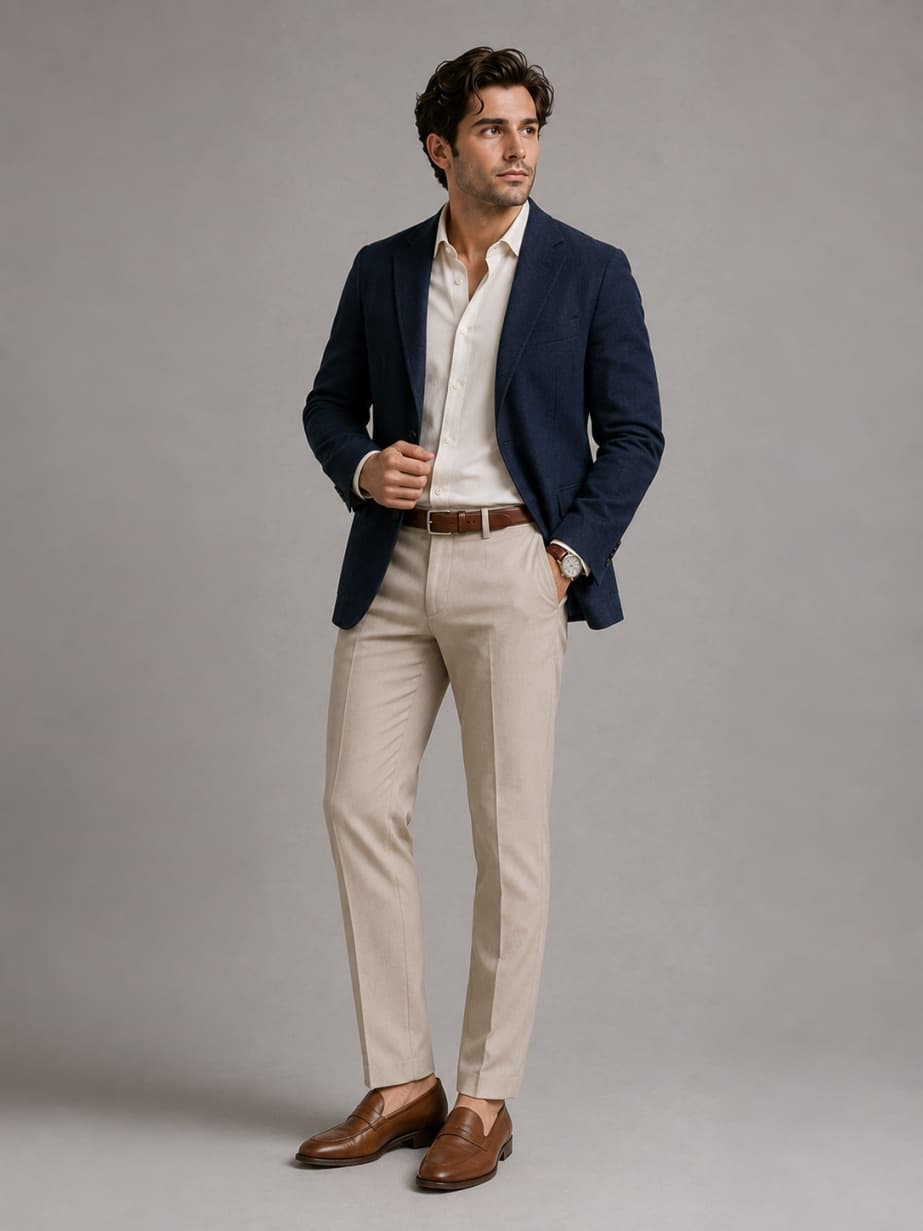
Smart casual for men is chinos or dark jeans, a knit polo or oxford shirt, an unstructured blazer or overshirt, and a leather shoe. No tie, no suit, and no sneakers you have run in. Navy, grey, stone and white cover it, and two things decide whether it works: where the jacket sits on your shoulder, and what condition the shoes are in.
One tailored piece per outfit — never zero, never four. Smart casual is a ratio, not a dress code.
Updated September 22, 2026
→ 02 / What defines it
→ 03 / Where it comes from
Smart casual is the newest code in the wardrobe, and the only one invented by offices rather than by clubs, courts or the military. Its two halves arrived separately. The tailored half descends from the sport coat: a jacket cut without matching trousers, worn for boating and shooting in nineteenth-century Britain precisely because it was not a suit. The relaxed half came from the slow collapse of the American office dress code — aloha-shirt Fridays in Hawaii in the 1960s, then an early-1990s push by denim and khaki makers who mailed casual dress-code guides to corporate HR departments, then the tech industry, which simply stopped asking. What was left was a code with no fixed list: no tie, no suit, but still a jacket’s worth of structure somewhere on the body. That vagueness is why people get it wrong, and why the ratio matters more than any single garment.
→ 04 / Smart Casual outfit ideas
Year-round
Why it works: The reason to own an unstructured jacket: it survives a whole day at a desk without looking slept in, which a suit jacket will not.
Year-round
Why it works: The knit polo is the most useful shirt in men’s smart casual. It has a collar, so the jacket has something to sit against, but it never needs pressing.
Cool
Why it works: An overshirt reads a notch softer than a blazer and a notch sharper than a sweatshirt, which is precisely the range this style lives in.
Warm
Why it works: Roll the sleeves before you take the jacket off, not after. An unlined jacket is the only kind worth wearing once it gets genuinely hot.
Year-round
Why it works: Blazer and separate trousers, not a suit split in half. The two shades have to be obviously different or it looks like you lost the matching piece.
Cold
Why it works: A rollneck under a coat gives you a finished neckline with no shirt and no tie, and it is the warmest version of this style there is.
→ 05 / Outfit examples
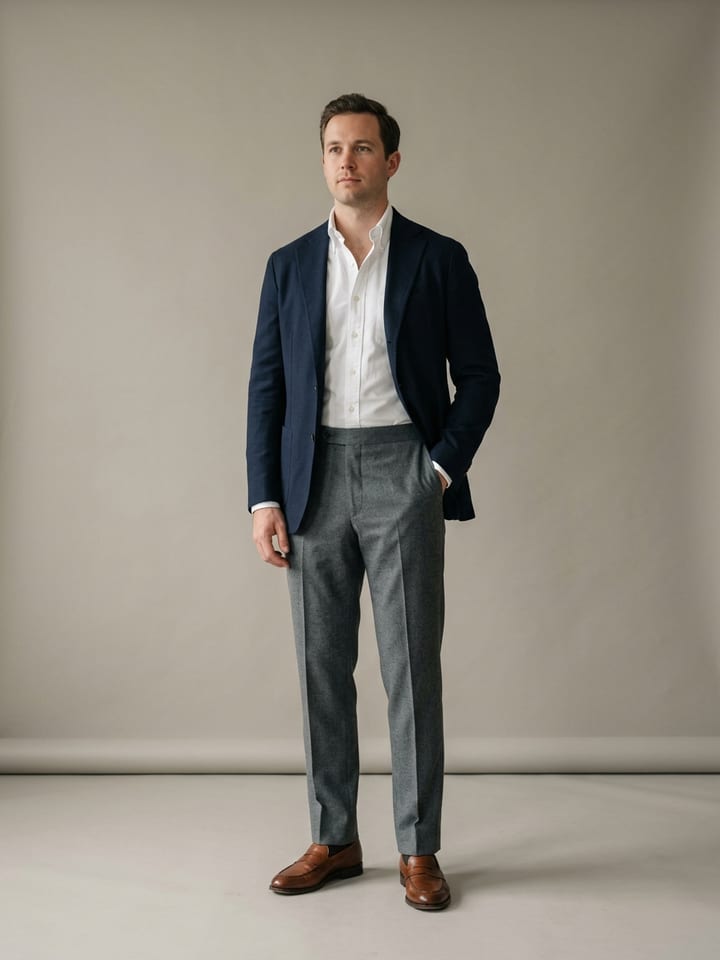
Grey wool trousers, a white oxford, an unstructured blazer.
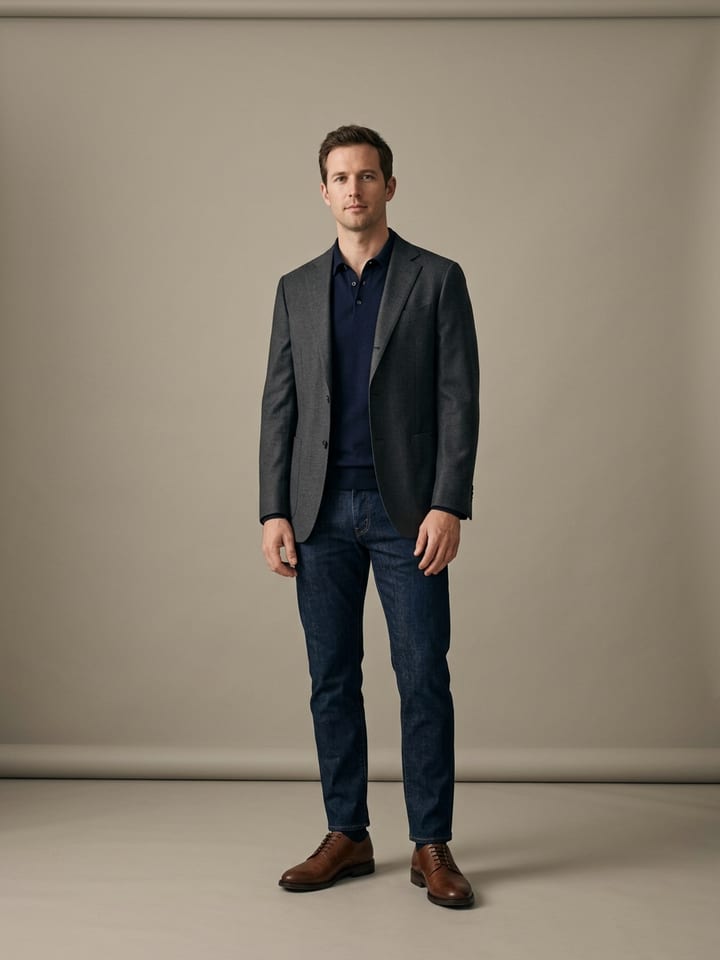
Dark jeans, a navy knit polo and a charcoal blazer.
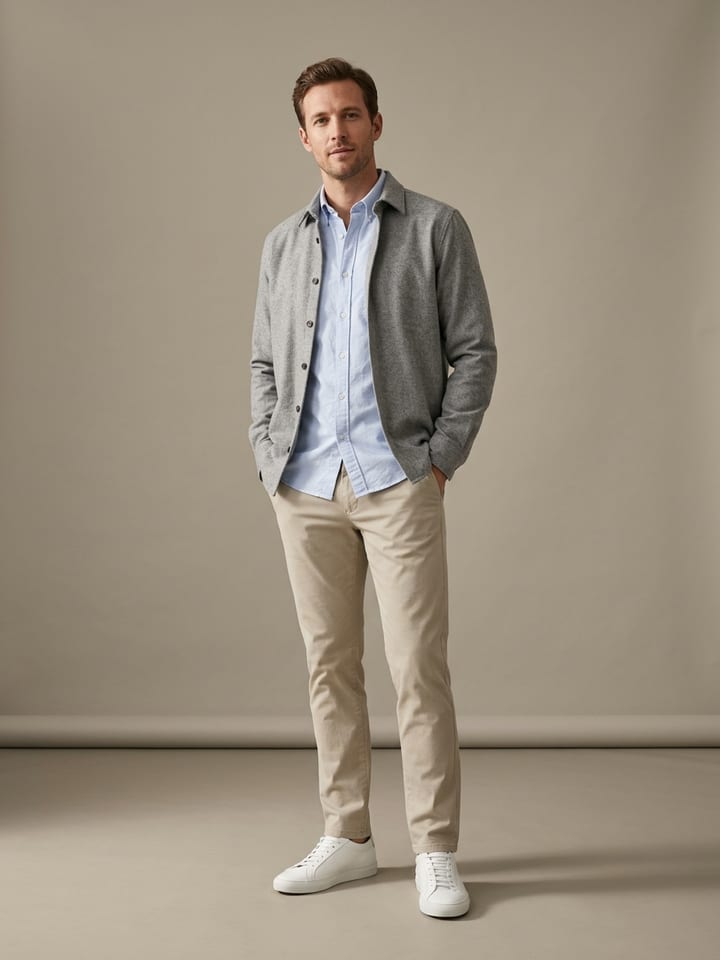
Stone chinos with an oxford shirt under a wool overshirt.
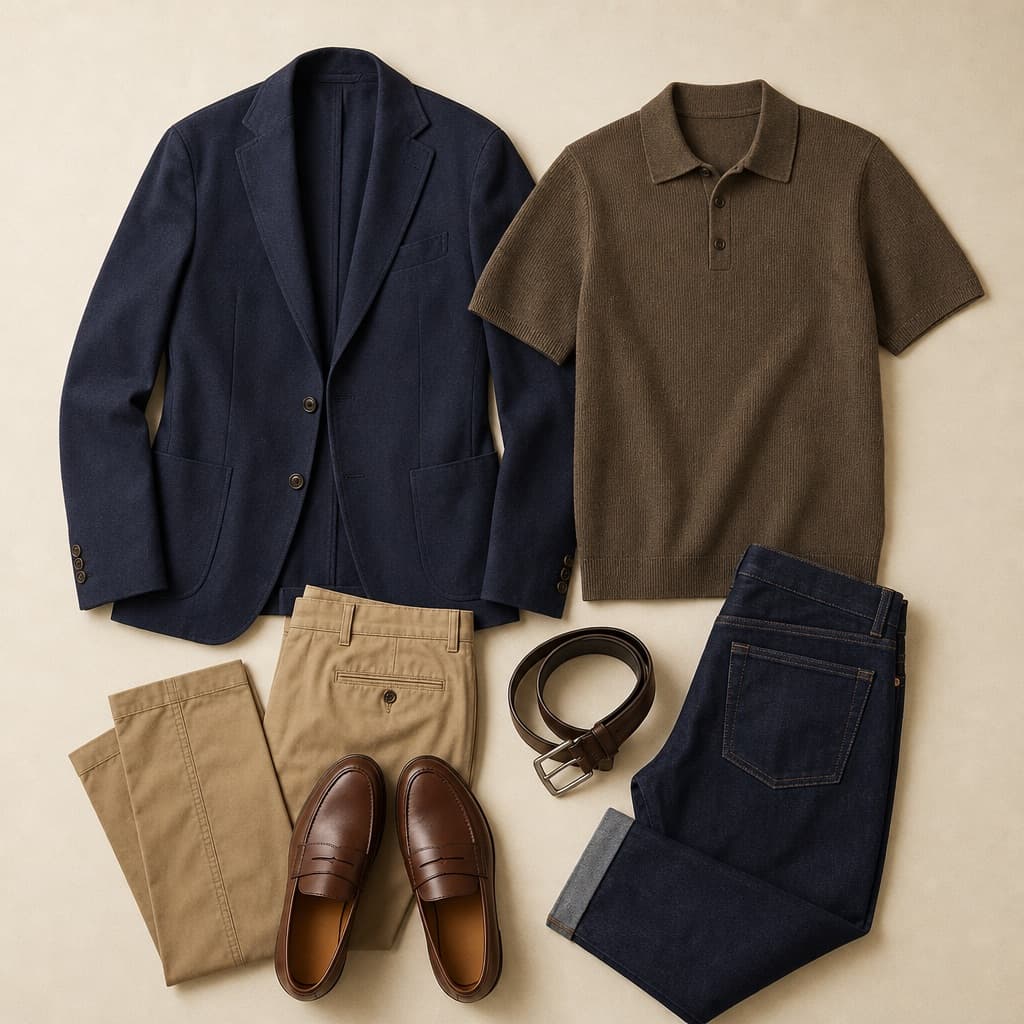
→ 06 / Key pieces · Men
→ 07 / Starter capsule
→ 08 / Palette & fabrics
Black as a daytime default, shiny suiting cloth, and any shirt with a contrasting collar. Sportswear logos on the outer layer kill it outright — a technical jacket or a swooshed sneaker turns the whole outfit casual no matter what is underneath.
→ 09 / Across the seasons
Drop the rollneck, bring back the oxford shirt, keep the jacket. One layer thinner is the entire adjustment.
Unlined jackets, linen blends, loafers without socks. If it is too hot for a jacket, a shirt with a real collar carries the outfit alone.
Flannel trousers, knit polos, an overshirt or a textured blazer. The one season where everything in the capsule works at once.
A navy or charcoal overcoat over the same clothes. Skip the puffer — nothing undoes a blazer faster than a technical shell worn over it.
→ 10 / Where it goes wrong
Wearing a suit jacket as a blazer. Worsted suiting has a sheen and a structure that announce the missing trousers from across the room.
Instead: Own one jacket that was never part of a suit: unstructured, slightly textured, navy or grey. It is the single most useful piece here.
Running shoes under tailoring. Mesh uppers, thick foam soles and a bright midsole undo the jacket from the ankle up.
Instead: Brown leather loafers or derbies for most of it, plus one pair of plain low-profile leather sneakers for the relaxed end.
Too little contrast between jacket and trouser. A navy blazer over navy trousers in a slightly different navy reads as an error, not a mix.
Instead: Make the gap obvious: navy over grey, grey over stone, or a textured jacket over a flat trouser.
Trouser length. A full break puddling over the shoe is the fastest way to look like the outfit was borrowed.
Instead: One light break, or none at all. Hemming trousers you already own costs less than a shirt and changes more.
→ 11 / How to start this week
→ 12 / Style icons, and what they actually wore
A navy jacket over a plain tee or a knit polo, tapered trousers, brown shoes. Repetitive on purpose, which is the entire point of a code like this.
Off duty in a soft grey jacket, a plain crewneck and dark jeans. The reference for how little the outfit needs once the jacket fits at the shoulder.
Shirt sleeves rolled, no tie, plain dark trousers, a leather belt matched to the shoes. Proof the code holds at the formal end with nothing added.
→ 13 / This might be you if...
→ 14 / Often confused with
→ 15 / Mixes well with
→ 16 / FAQ
Smart casual for men is the middle ground between office and weekend — relaxed pieces sharpened by one or two tailored ones. An unstructured blazer, knit polo, or loafer is the usual upgrade.
Do add one tailored piece: an unstructured blazer, chinos, or a leather belt. Do keep fits clean. Do let shoes finish it: loafers or derbies, not running sneakers.
Don’t wear a matching suit and tie (that’s classic) or a hoodie as the hero (that’s casual). Don’t pair a blazer with gym shorts or collapsing trainers. Don’t leave the shirt wrinkled if the rest is trying.
Men can wear Smart Casual to the office, client lunches, dinners, dates, and any weekday that is not a tuxedo. It is the look that works from desk to dinner without a costume change.
Typical colors for men’s Smart Casual are navy, beige, white, and grey, in wool, oxford cloth, and fine knit. Quiet neutrals make the tailoring do the talking.
A common Smart Casual mistake for men is the half-upgrade: a blazer over a graphic tee and dirty sneakers. Either commit to one polished piece and clean shoes, or stay casual on purpose.
Two minutes of swiping tells you whether Smart Casual is genuinely your Style DNA — or just the jacket you throw on when you need to look serious.
Take the style quizYou are cordially invited
Modesona is your personal stylist — free, instant, and built around everything already hanging in your wardrobe.


Free · No card required · iOS & Android