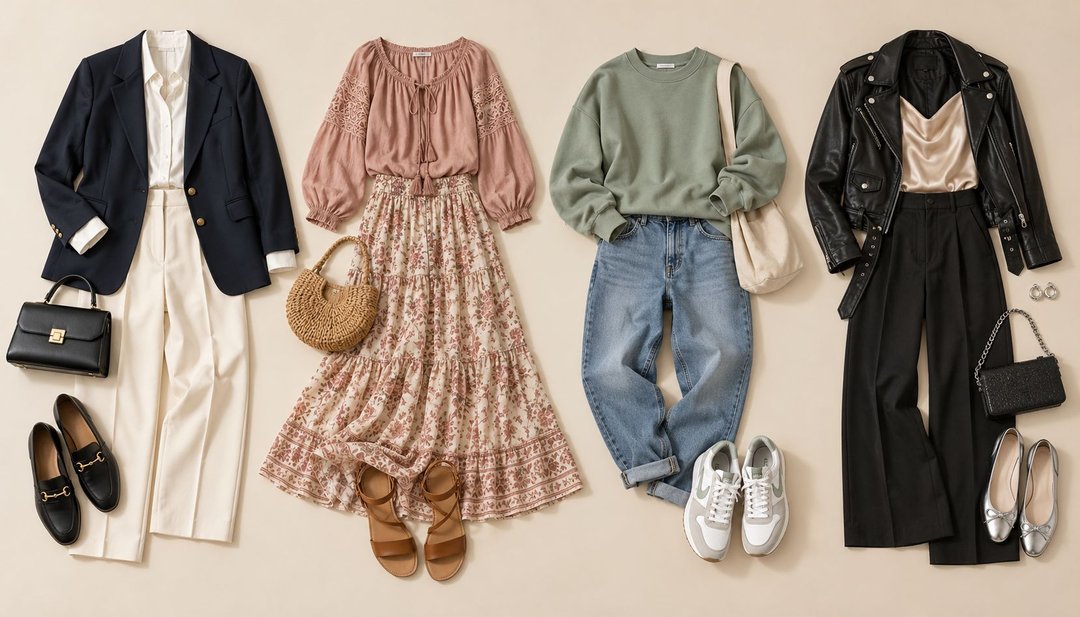
Wedding Dress Codes Explained: How to Understand the Invitation
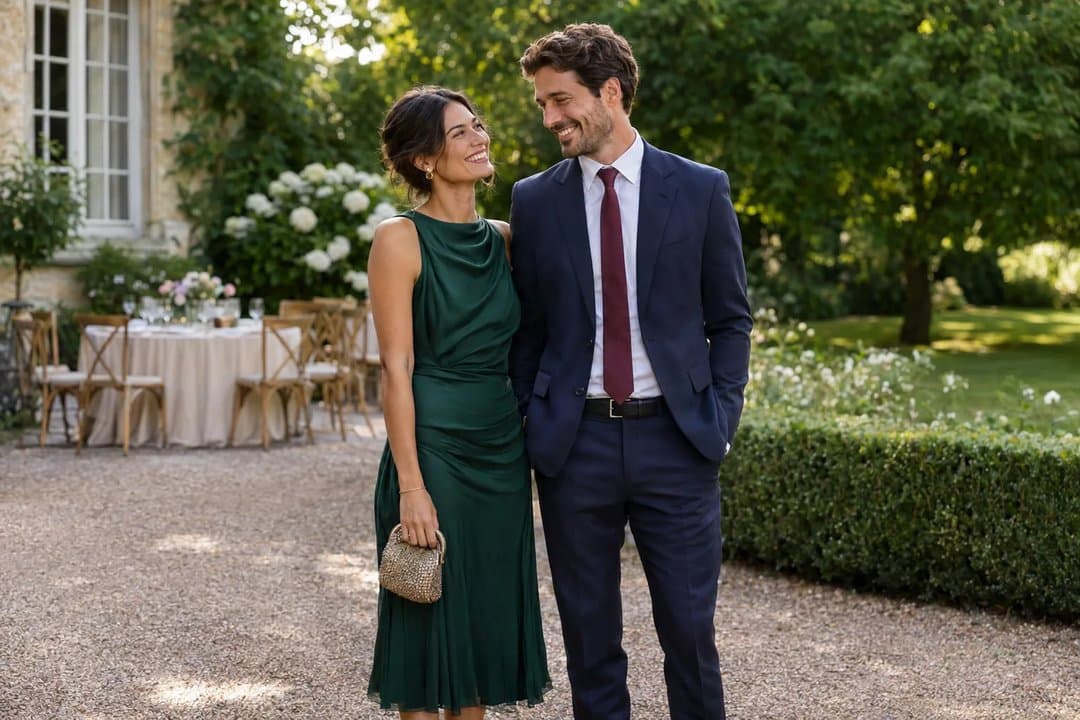
Wedding dress codes tell you how formally to dress. White tie and black tie have relatively specific traditions, while terms such as formal, cocktail, semi-formal, and dressy casual leave more room for interpretation.
The most useful starting point is the couple’s actual wording. Read the invitation and wedding website together, separate the level of formality from any theme, and clarify anything that could change your choice before buying or renting clothes.
You may already own something suitable. Understanding the dress code helps you recognize those options—and identify when a small styling change will be enough or a different garment is needed.
This guide explains the language on the invitation. When you are ready to translate that language into a complete outfit, explore these wedding guest outfit ideas.
How to read a wedding dress code before choosing clothes
An invitation can contain several kinds of instructions at once:
- Formality: black tie, formal, cocktail, or casual.
- Setting: beach, garden, rooftop, or countryside.
- Theme: festive, vintage, tropical, or another aesthetic.
- Color direction: a suggested palette or a specific color request.
- Ceremony requirements: guidance about head coverings, covered shoulders, footwear, or other customs.
These instructions answer different questions.
For example, “garden formal” does not simply mean “wear florals.” The word formal describes the expected level of dress; garden gives you additional context.
Likewise, an invitation asking for “cocktail attire in bright colors” gives you both a formality level and a palette. You need to consider both.
Use this order when the instructions seem unclear
- Read the exact dress-code wording. Look for words such as required, optional, encouraged, or suggested.
- Check the wedding website. The FAQ or schedule may include examples or separate instructions for different events.
- Check which event the instruction applies to. A welcome dinner and the wedding ceremony may have different codes.
- Identify the remaining uncertainty. Is it the garment category, the color, the ceremony requirements, or something else?
- Ask a specific question. Describe the choice you are considering rather than asking someone to define “nice.”
A useful question might be:
“The invitation says formal. Would an evening midi dress be suitable, or are you hoping guests will wear floor-length gowns?”
That is easier to answer than “How dressed up should I be?”
Wedding dress codes at a glance
Use this table to identify the starting point, then read the relevant explanation below. These are contemporary wedding conventions, not a universal system followed identically by every family or venue.
| Dress code | Main meaning | Women’s attire | Men’s attire | What to clarify |
|---|---|---|---|---|
| White tie | Highly formal evening dress with specific traditional requirements | Full-length formal evening gown. | Evening tailcoat, formal trousers, white waistcoat, and white bow tie. | Whether alternatives or particular accessories are expected |
| Black tie | Formal eveningwear; a tuxedo is the conventional tailored option | Floor-length evening gown; a very dressy cocktail dress if accepted by the hosts. | Tuxedo with an evening shirt and black bow tie. | How traditional the hosts’ interpretation is |
| Black-tie optional | Black tie is welcome, with other formal options accepted | Evening gown, dressy cocktail dress, or formal separates. | Tuxedo, or a dark suit with a dress shirt and tie. | Whether the website gives examples of those alternatives |
| Formal | A dressed-up celebration with some flexibility | Evening gown, dressy cocktail dress, or formal pantsuit; confirm daytime versus evening expectations. | Dark matching suit with a dress shirt and tie; a tuxedo where requested or welcomed. | Whether the hosts mean evening formalwear, formal daywear, or black-tie optional |
| Cocktail | Occasionwear below the level of a gala or white-tie event | Cocktail dress, dressy jumpsuit, or occasion separates. | Suit and dress shirt; include a tie unless the hosts indicate a more relaxed interpretation. | Any preferences about suits, ties, or garment styles |
| Semi-formal | Dressed-up clothing with more flexibility than strict formalwear | Dressy day dress, cocktail dress, or dressy pantsuit, depending on the event. | Suit, or blazer with dress pants where accepted; check whether a tie is expected. | How the hosts distinguish it from cocktail or dressy casual |
| Dressy casual / smart casual | A polished but relatively relaxed presentation | Polished day dress, skirt and blouse, or dressy pants outfit. | Dress pants or chinos with a collared shirt; jacket and tie depend on the invitation. | Whether jackets, ties, denim, or particular footwear are addressed |
| Casual | Relaxed clothing appropriate to the celebration | Relaxed day dress, or a skirt or pants with a blouse or other neat top. | Chinos or dress pants with a collared shirt; follow any specific jacket or tie guidance. | What “casual” means for this particular wedding |
Some of these categories overlap. If the invitation uses two terms together, such as “semi-formal/cocktail,” read the accompanying examples as the clearest description of what the hosts intend.
White tie: the most formal evening dress code
White tie is a specific traditional evening code. The conventional tailored outfit includes a black evening tailcoat, matching formal trousers, a white waistcoat, and a white bow tie. The conventional dress option is a full-length formal evening gown.
A tuxedo and a white-tie tailcoat are different garments. Changing the color of a bow tie does not turn one into the other.
Long evening gloves are associated with white tie, although their use varies by event and they are not always required. Check the hosts’ expectations rather than assuming every historical accessory is compulsory.
Before committing to a purchase or rental: write down the complete requirements. If the invitation permits national dress or another alternative, confirm what that means for the event.
White tie is a situation where checking one missing detail early can prevent hiring an unsuitable outfit.
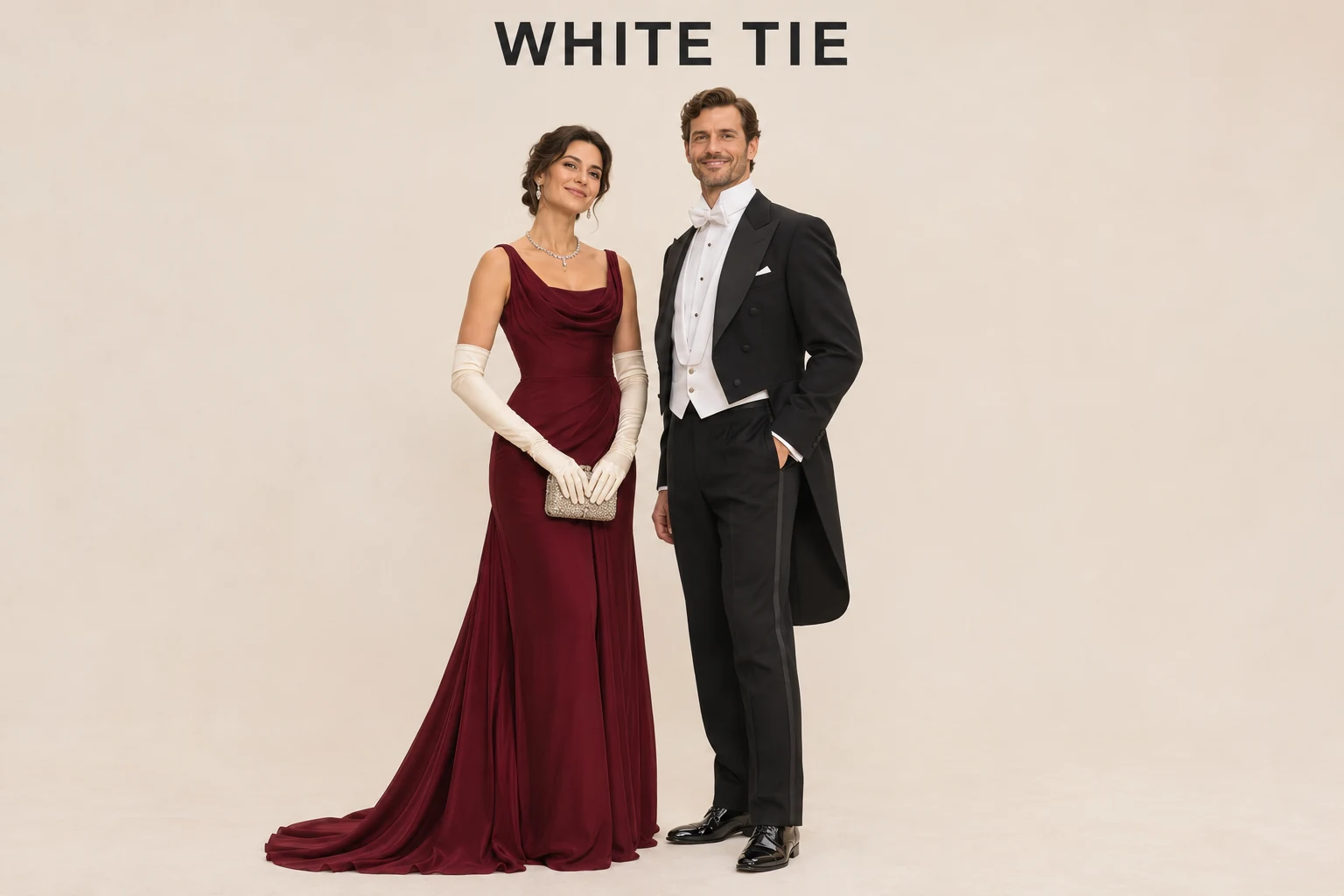
A traditional white-tie example: a full-length evening gown and evening tailcoat with a white waistcoat and bow tie. Confirm any accessory requirements with the hosts.
Black tie: formal eveningwear, with a defined starting point
For traditional tailored dressing, black tie means a tuxedo rather than an ordinary dark business suit. The conventional combination includes an evening shirt, a black bow tie, and appropriate formal footwear.
For dresses, a floor-length evening gown is a straightforward interpretation. Some etiquette guidance also accepts exceptionally dressy cocktail dresses: the Emily Post Institute includes both in its black-tie attire guidance.
That flexibility does not mean every shorter dress is equally suitable. Consider the garment’s construction, fabric, finishing, and overall evening character.
What to check in your own closet
Separate two questions:
- Is this garment suitable for a formal evening event?
- Does it suit this particular invitation?
An outfit may answer the first question but still conflict with an explicit color request or ceremony instruction.
If you are considering an alternative to conventional eveningwear, clarify that option with the hosts. You do not need to force yourself into an uncomfortable garment, but it helps to agree on a suitable alternative before the day.
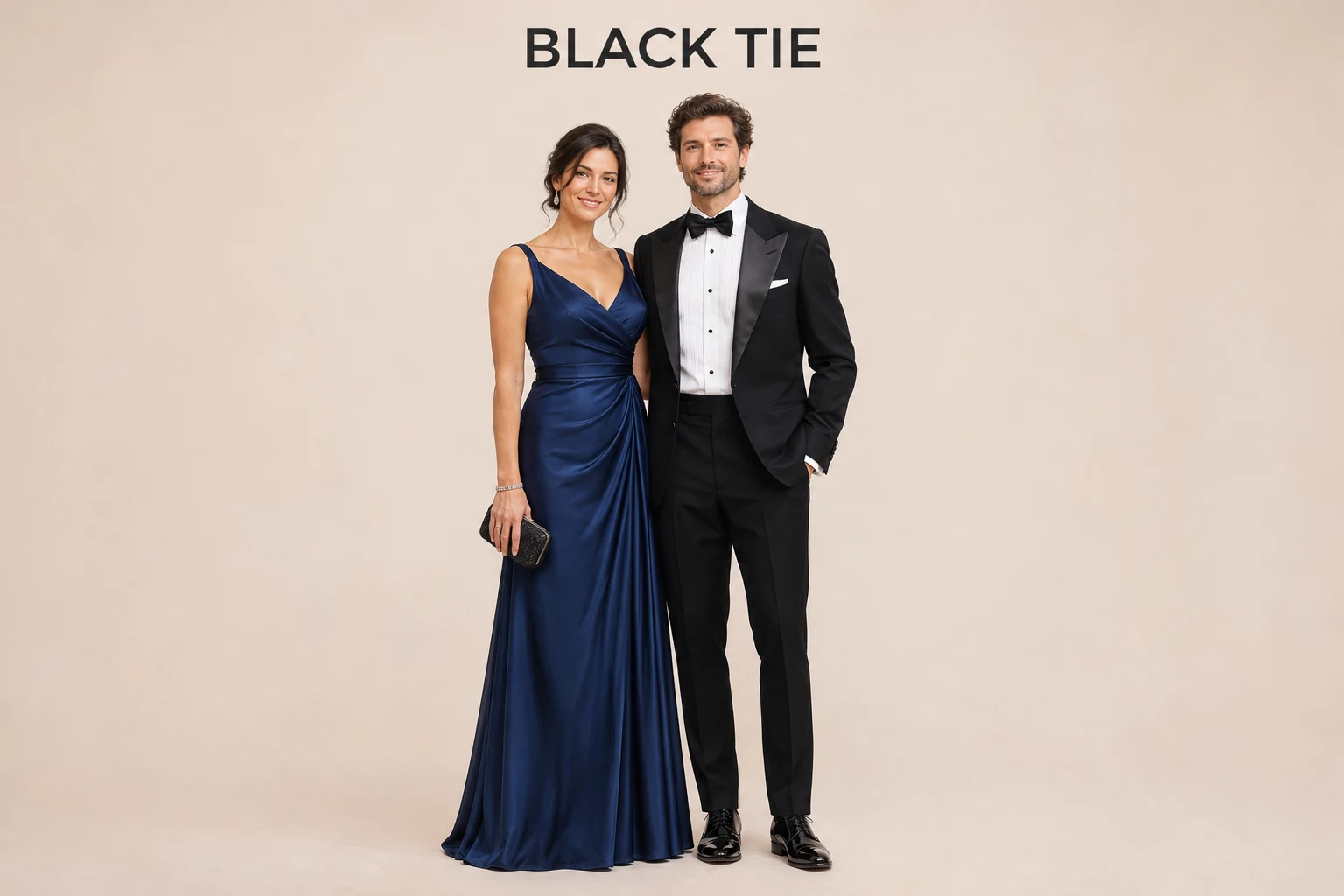
One black-tie interpretation: a floor-length evening gown and a tuxedo with a black bow tie.
Black-tie optional: the alternative is still formal
Black-tie optional means guests may wear black tie, but other formal choices are accepted.
The Emily Post Institute includes a dark suit as an alternative to a tuxedo, and an evening gown, dressy cocktail dress, or dressy separates among the other options in its dress-code guide.
The word optional applies to the black-tie interpretation. It does not make the event itself casual.
How to make the decision
If you already own suitable black-tie clothing, the invitation gives you an opportunity to wear it.
If you own another formal option that fits the hosts’ guidance, you may be able to use that instead.
If neither is available, compare borrowing, renting, and buying after you have confirmed the requirements. There is little value in purchasing something based on an assumption that the website could resolve.
Also distinguish optional from preferred. “Black tie preferred” communicates a stronger preference, although the hosts may still offer alternatives. Read their explanation before deciding.
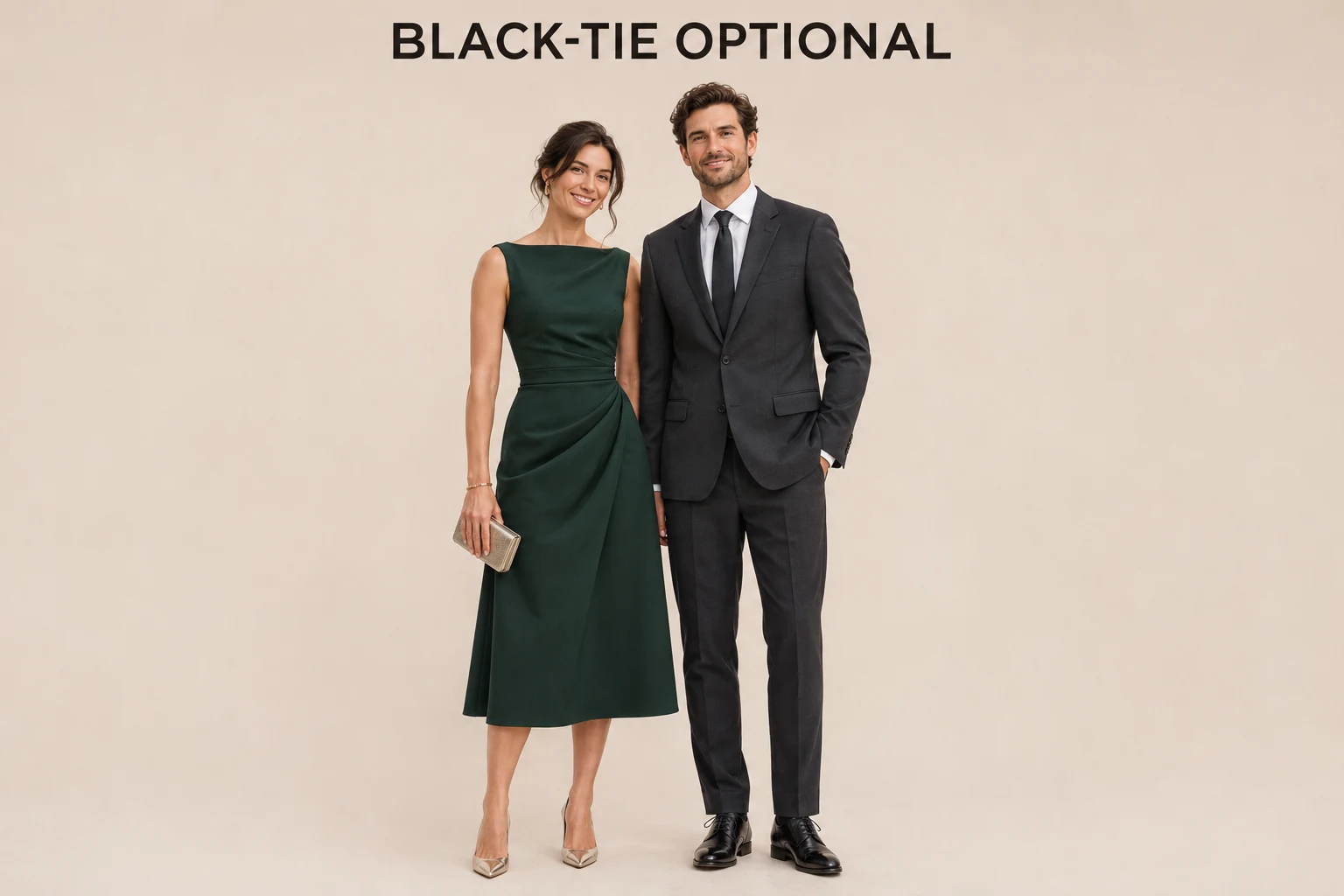
One formal alternative for black-tie optional: a dressy cocktail dress and dark suit. A gown and tuxedo remain suitable options.
Formal: check the context before treating it as a synonym
“Formal” can be less precise than “black tie.”
Some wedding invitations use it close to black-tie optional. Others distinguish formal daytime clothing from eveningwear. Emily Post’s wedding guest attire guidance makes this daytime and evening distinction.
The practical consequence is that you should not automatically translate every formal invitation into “a gown or tuxedo is mandatory.”
What makes this label easier to interpret?
Look for an additional sentence:
- “Formal attire; dark suits and evening dresses.”
- “Formal daywear.”
- “Formal attire; tuxedos welcome but not required.”
These examples are illustrative, but they show why the explanation matters more than trying to assign the word a single fixed definition.
If there is no explanation, ask about the specific option you own. That helps you establish whether it meets the hosts’ expectations without creating an unnecessary shopping list.
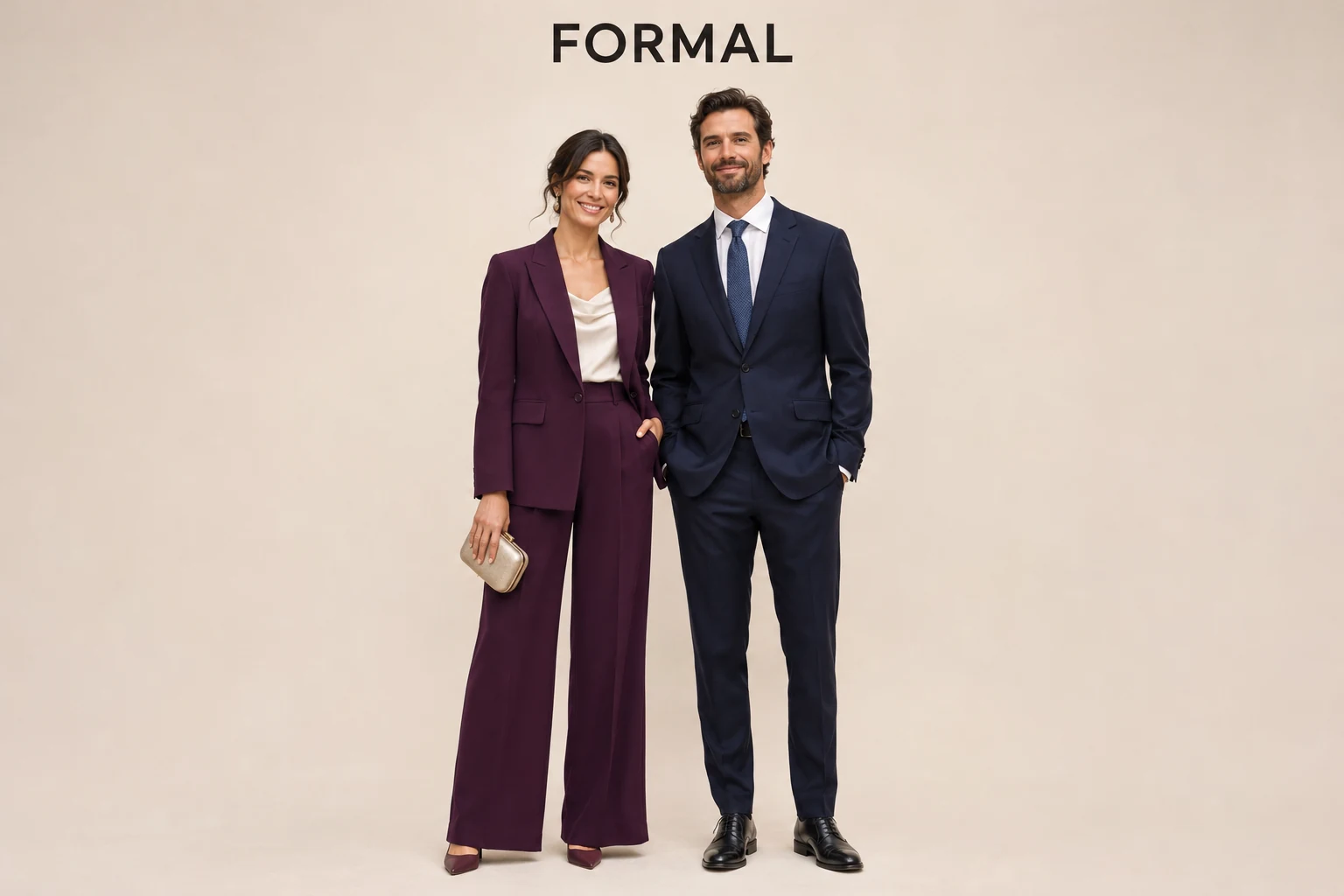
A tailored interpretation of formal wedding attire. Check whether the hosts specify formal daywear, eveningwear, or black-tie optional.
Cocktail: dressed-up occasionwear with room for personal style
Cocktail attire sits below the strictest evening codes and allows more variety in clothing and styling.
A cocktail dress, an occasion jumpsuit, dressy separates, or a suit may provide an appropriate starting point, depending on the invitation. If you prefer tailored clothing, check whether the hosts expect a matching suit or also welcome a blazer with dress pants.
What cocktail does—and does not—tell you
It gives you a level of dress. It does not specify a single hemline, color, or silhouette that every guest must wear.
It also does not automatically require sequins, heels, or a new outfit.
When considering a piece you own, ask whether it was designed or styled for an occasion. Then check the whole combination. The same garment can look different with a change of shoes or a jacket, but accessories cannot resolve every mismatch in formality.
If the hosts specify suits, ties, or particular examples, use those instructions to narrow the possibilities.
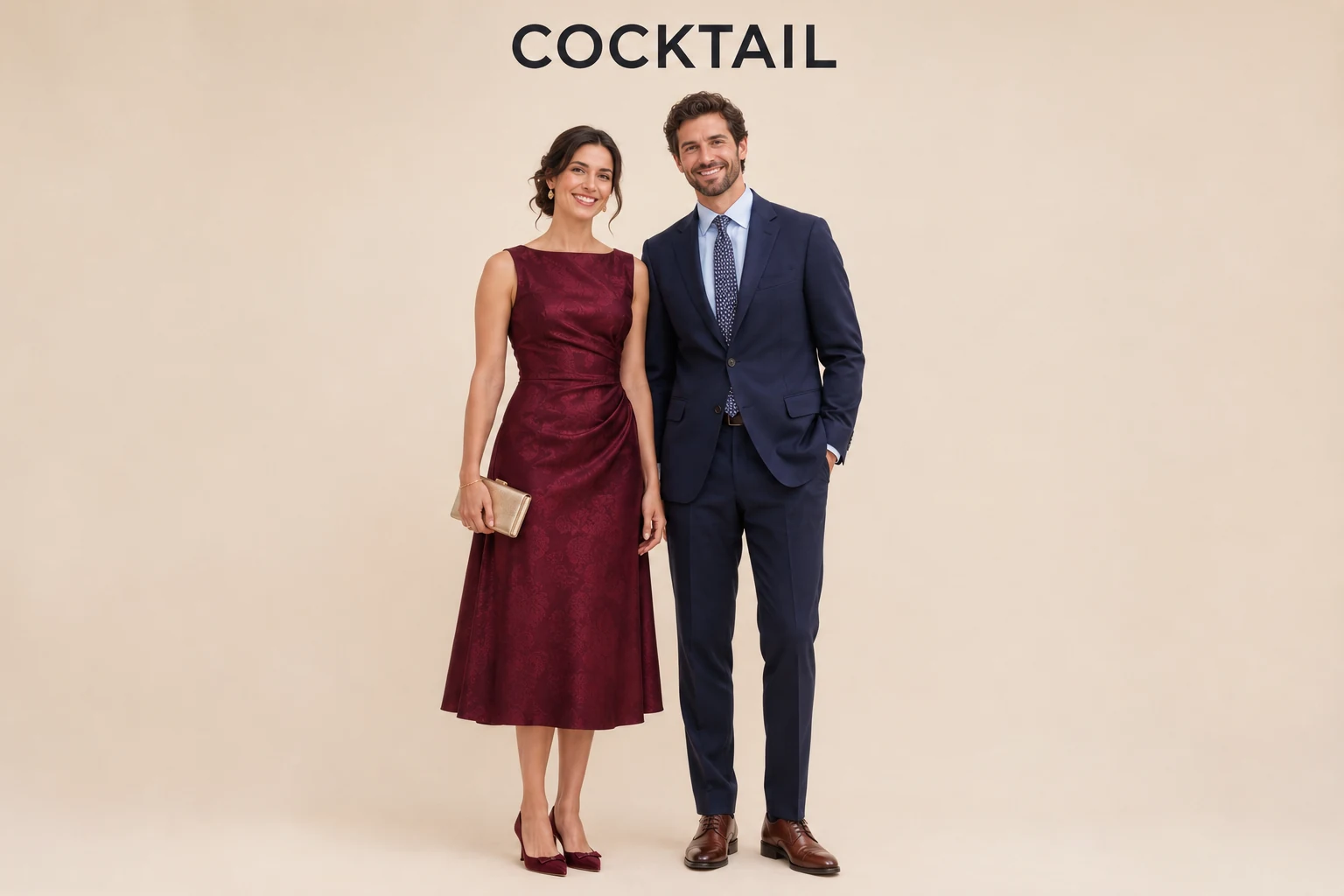
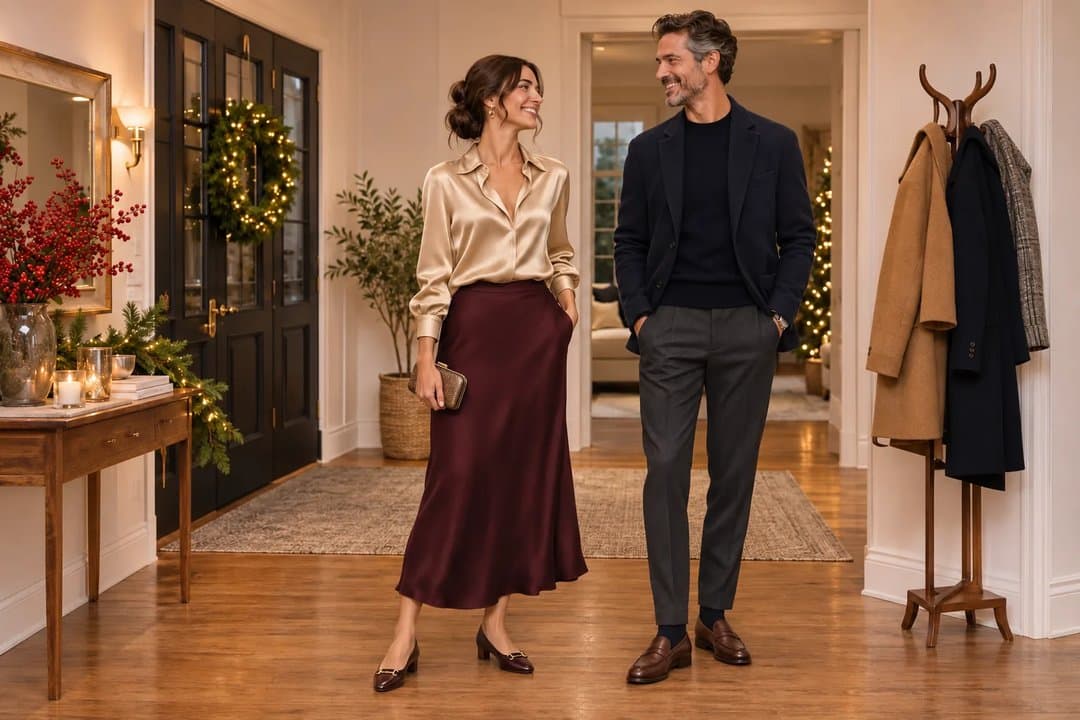
A cocktail dress and suit offer one interpretation of cocktail attire. The invitation may allow other occasionwear.
Semi-formal: a flexible category that often overlaps with cocktail
Semi-formal usually indicates a dressed-up event without the requirements of strict formal eveningwear.
The difficulty is that people use the term differently. Some treat semi-formal and cocktail as interchangeable. Others use semi-formal for a slightly more relaxed interpretation.
You are unlikely to settle that difference by comparing dozens of online charts. The hosts’ examples are more useful.
How to resolve the overlap
If the website says “semi-formal: cocktail dresses, jumpsuits, and suits,” you have a clear description.
If it says only “semi-formal,” ask about the garment category that affects your decision:
“Would a blazer with dress pants fit the dress code, or would you prefer a matching suit?”
Avoid turning a flexible term into an overly precise rule. The goal is to understand this event, not prove that one definition is correct everywhere.
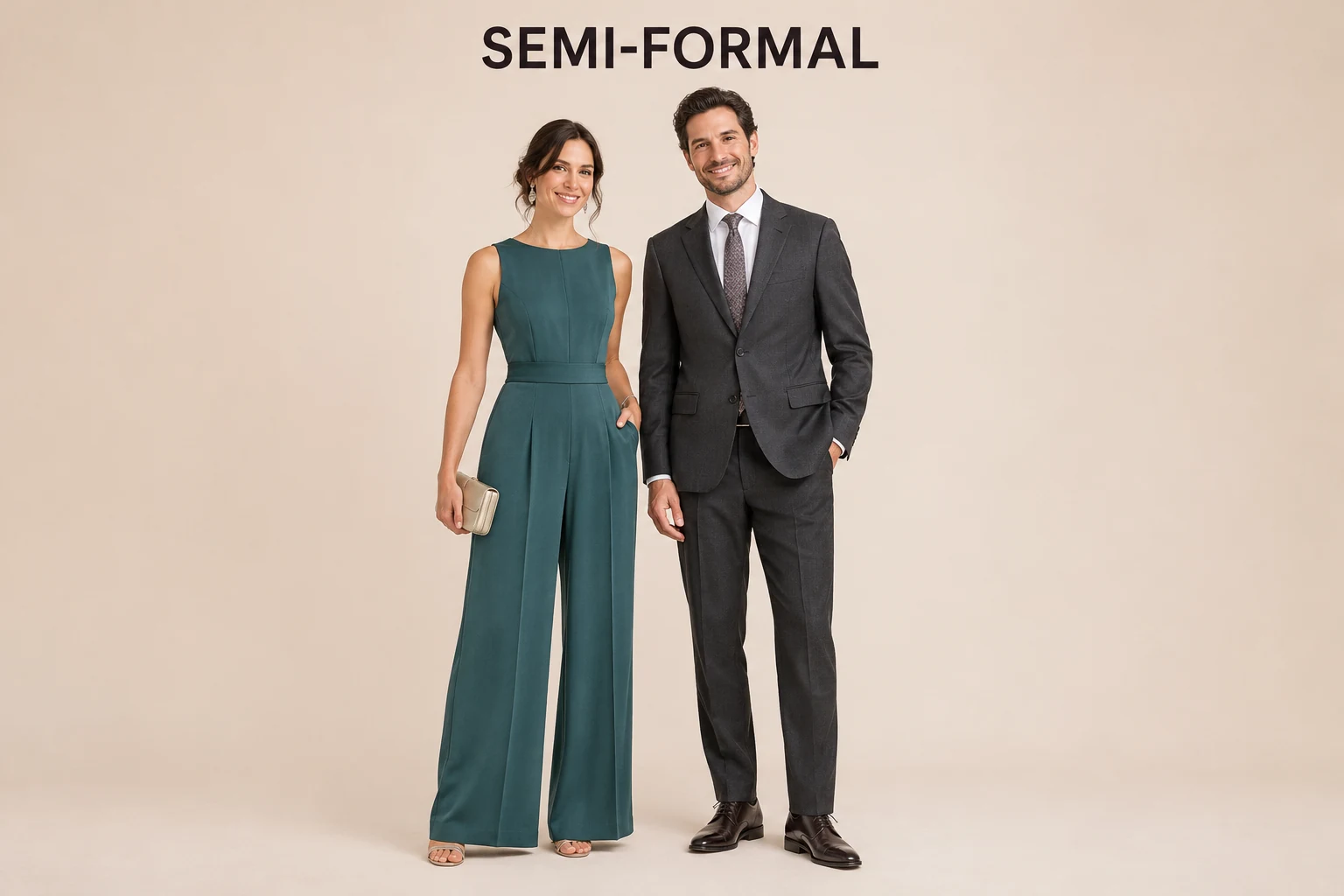
A dressy jumpsuit and suit are one semi-formal interpretation. This level can overlap with cocktail; use the hosts’ examples to clarify.
Dressy casual and smart casual: clarify how relaxed the hosts intend to be
Dressy casual and smart casual generally describe a polished appearance with more flexibility than formal occasionwear.
These terms can leave several practical questions unanswered. Does the couple expect a jacket? Are ties optional? Have they explicitly welcomed denim or sneakers?
Instead of assuming the same interpretation you use for a restaurant or workplace, check the wedding guidance.
A useful closet test
Imagine the complete outfit you are considering, including shoes and any outer layer you will keep on.
Then ask:
- Which part makes it feel appropriate for a celebration?
- Which part might make it feel more relaxed than the hosts intend?
- Is there one uncertain item I can ask about?
This is more useful than replacing every piece just because the code contains the word dressy.
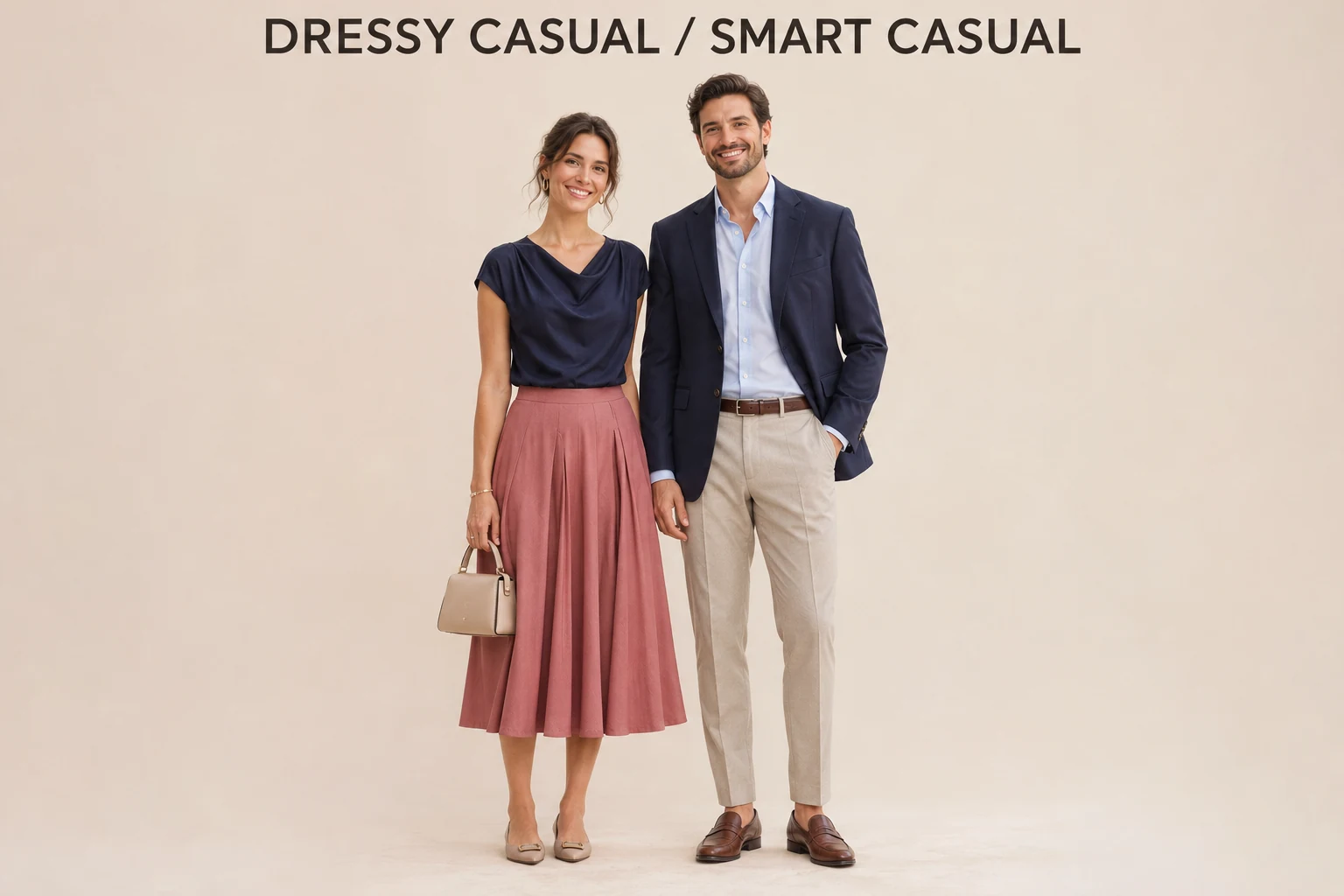
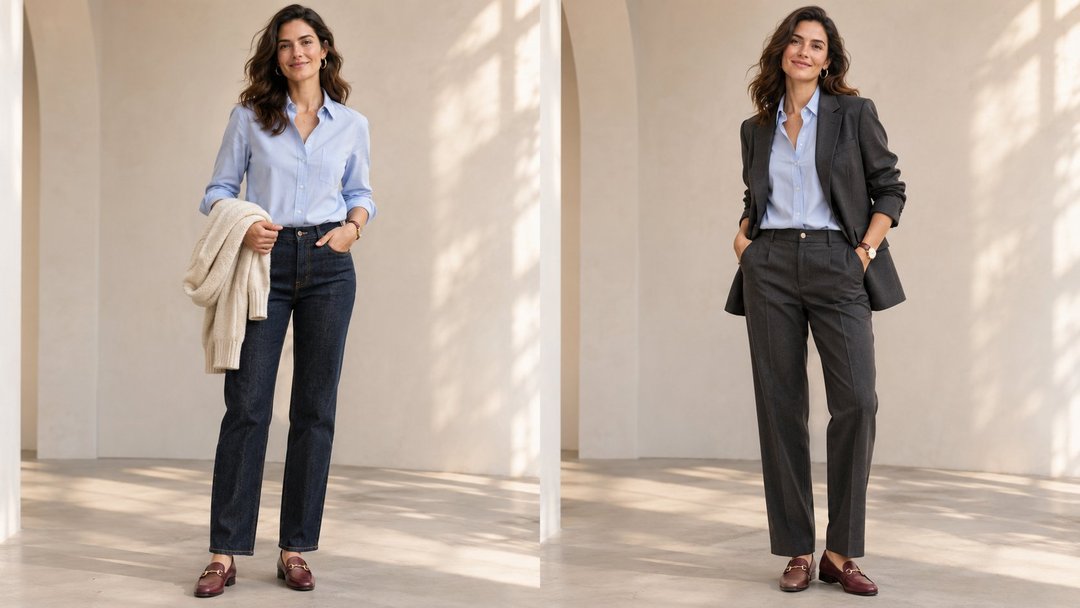
One polished daytime interpretation of dressy casual. Confirm any expectations about jackets, ties, and footwear.
Casual: relaxed expectations still need context
A casual wedding gives guests more freedom, but the couple may still have specific expectations about clothing.
For a casual wedding, check whether the couple explicitly welcomes everyday items such as jeans, shorts, or sneakers.
If the website says “casual—jeans and clean sneakers welcome,” that is useful permission. If it simply says “casual,” do not assume that every item in your everyday wardrobe has been addressed.
Ask when the answer changes your choice. Otherwise, work with the clearest guidance available and choose something you can comfortably wear throughout the event.
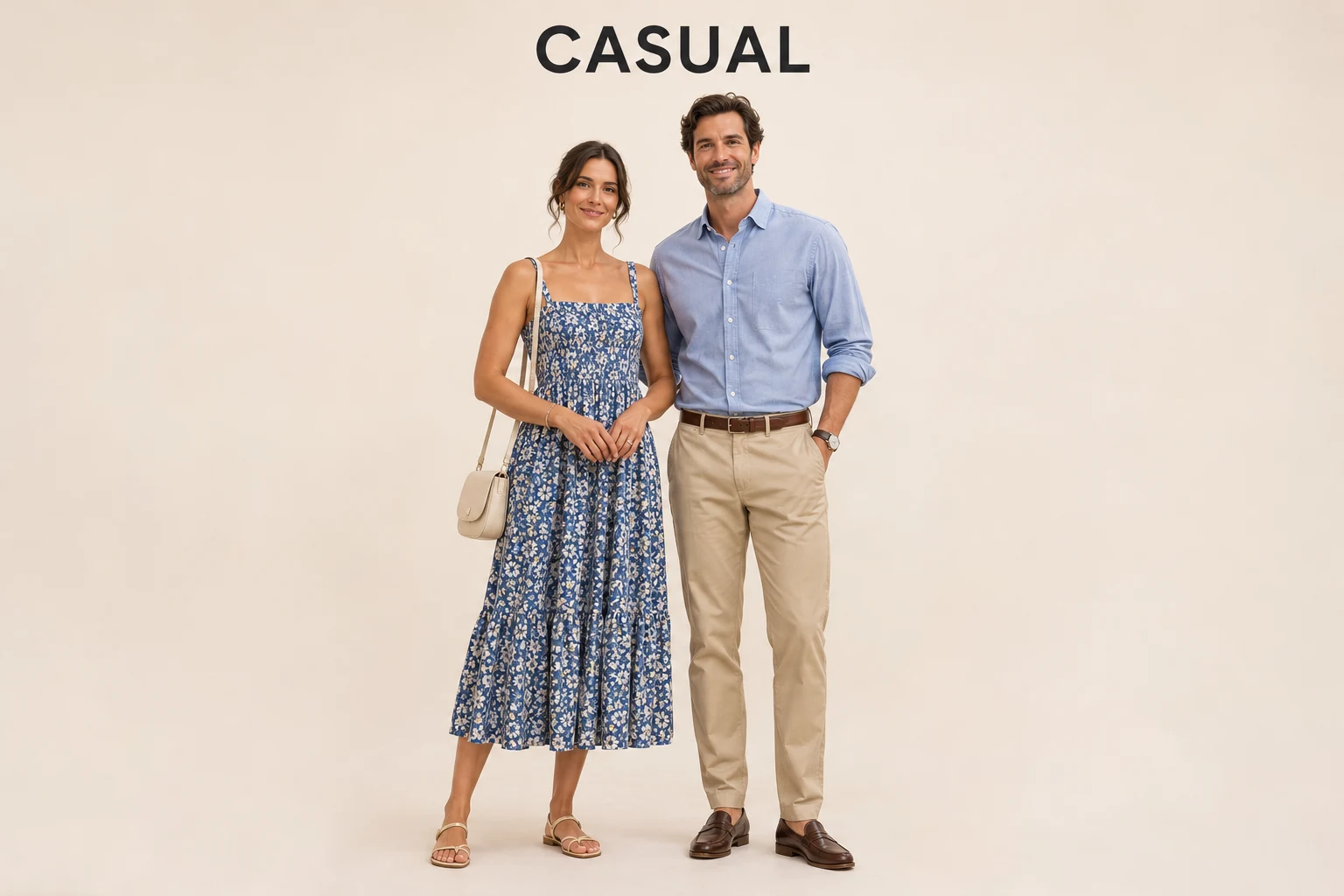
A relaxed wedding-guest example with a cotton day dress and chinos. Follow the couple’s specific guidance rather than assuming all everyday clothing is accepted.
The differences guests most often confuse
Black tie vs. black-tie optional
The distinction concerns the accepted alternatives.
With black tie, start from formal eveningwear. With black-tie optional, the hosts have explicitly allowed another formal route.
If you are choosing between renting eveningwear and wearing an existing dark suit, this wording can materially change your decision.
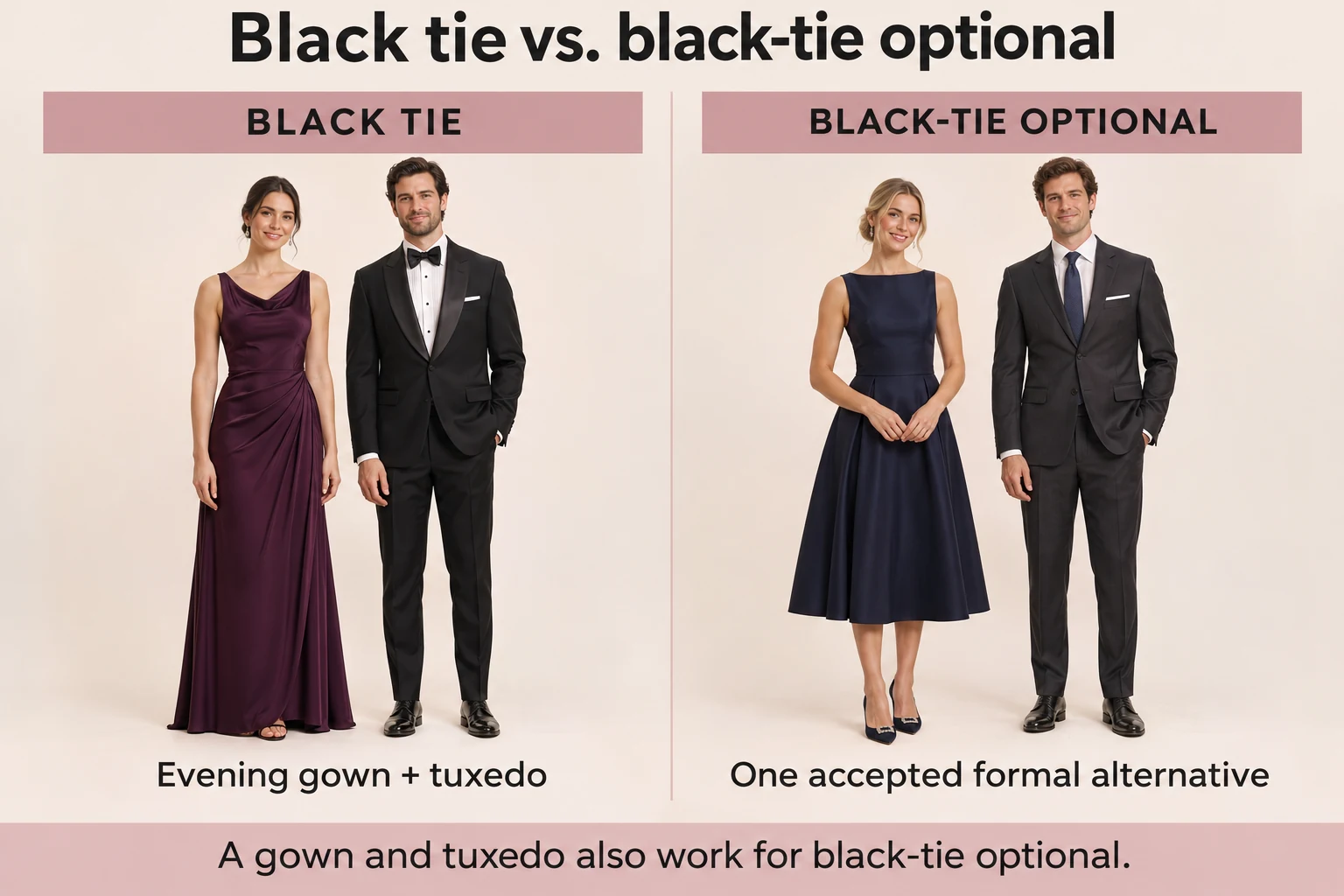
Black tie starts with formal eveningwear. Black-tie optional also accepts formal alternatives such as a dressy cocktail dress and a dark suit; a gown and tuxedo remain suitable.
Formal vs. black-tie optional
These terms can overlap, but they are not guaranteed to carry identical expectations.
Black-tie optional names the relationship to black tie. “Formal” requires more context, especially when comparing daytime and evening celebrations.
Cocktail vs. semi-formal
There is no consistently enforced boundary across all contemporary weddings.
When the invitation combines them, use the hosts’ examples. When it distinguishes them—for example, cocktail at the welcome party and semi-formal at another event—check whether the website explains the intended difference.
Dressy casual vs. casual
The difference often lies in how polished the complete outfit should be, but neither term settles every clothing question.
A specific instruction such as “jackets optional” or “no denim” is more actionable than the label alone.
Dress length, fabric, and price: why one detail cannot decide everything
A garment’s name or length does not tell you its full level of formality.
A long dress can be a casual vacation piece. A shorter dress can be designed for an evening occasion. A suit can look sharply tailored or deliberately relaxed.
When evaluating something you already own, look at several details together.
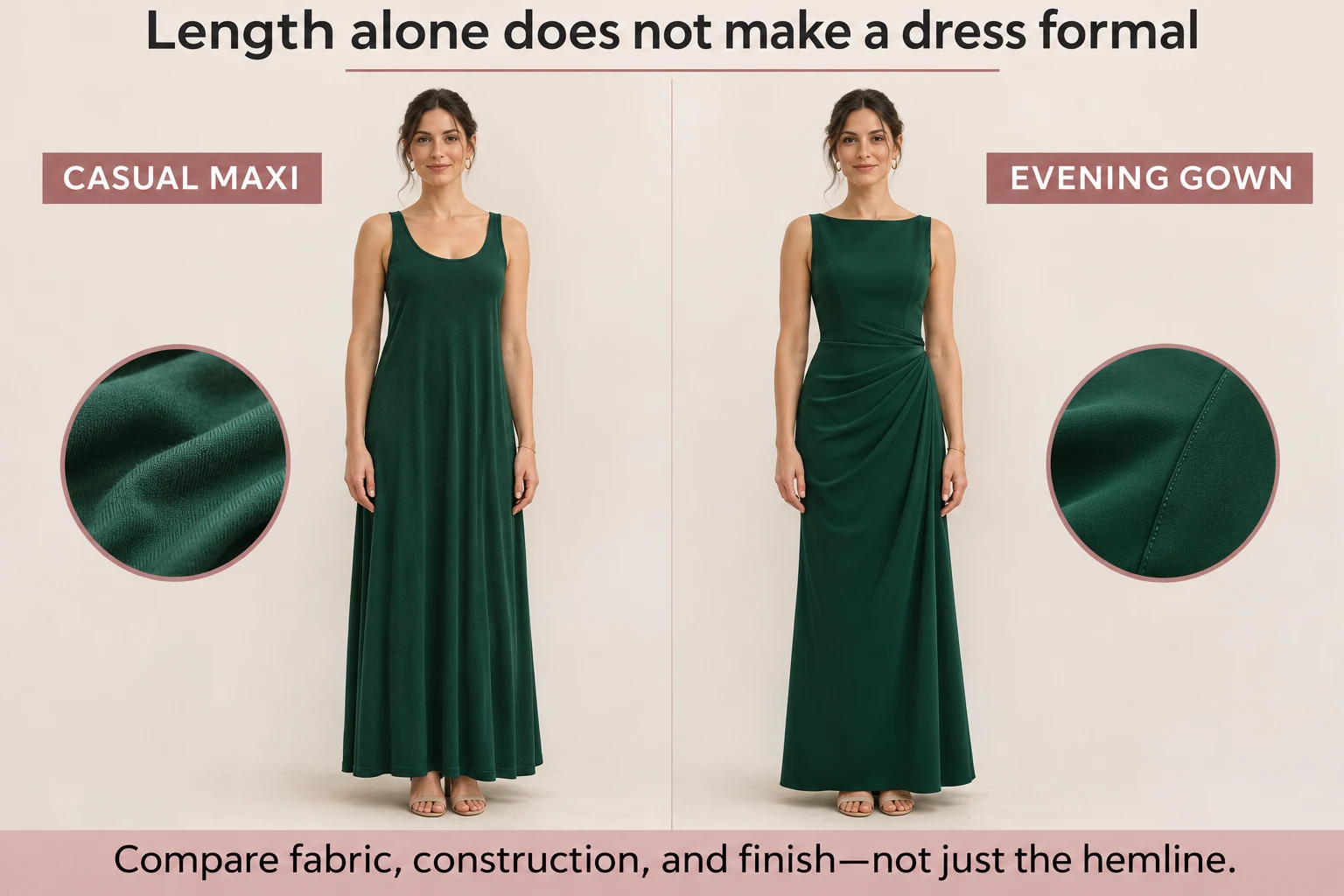
Both dresses are long and green. Fabric, construction, and finishing distinguish the casual maxi from the evening gown.
Construction and shape
Does the garment hold its intended shape? Does it have structure, draping, or finishing that suits the occasion?
You do not need a fitted silhouette to look dressed up. A loose garment can be intentional and carefully finished.
Fabric and surface
Look at the actual material rather than relying on a product label.
Does it have the appearance you want in daylight and indoor lighting? Is the lining visible? Does the surface look worn in places that matter to you?
A shiny finish alone does not establish formality. Nor does a matte finish automatically make clothing casual.
The complete combination
Try the main garment with the shoes, bag, jewelry, and outer layer you intend to use.
Photograph the result if that makes comparison easier. Look at the outfit as a whole rather than judging isolated pieces on hangers.
Condition and readiness
An existing garment may need cleaning, steaming, a repaired fastening, or an adjusted hem.
Those are different problems from owning the wrong type of garment. Identify which problem you actually have before replacing it.
Price is not a dress code. A costly piece can be unsuitable for an invitation, while a borrowed or secondhand piece can meet the requirements.
“Beach,” “garden,” and “festive”: separate the theme from the formality
A setting or aesthetic can modify a dress code without replacing it.
In wording such as “festive cocktail” or “festive formal,” the modifier and the underlying code work together. Read the invitation for both the requested level of formality and the suggested style.
Beach formal
Read both words. If you are unsure what the couple expects, ask whether they have examples.
Do not decide that the location cancels the stated formality.
Garden party or garden formal
“Garden” might describe the location, the visual direction, or both.
A floral pattern may fit the theme, but it does not establish whether the outfit meets the requested level of dress.
Festive attire
Festive can invite more expressive color, texture, or accessories. When paired with another code, keep that underlying level in view.
If “festive” appears on its own, ask what range of clothing the hosts have in mind.
Creative black tie
Creative black tie retains a black-tie foundation while allowing more individual expression. It is different from an unrestricted costume theme.
Before buying a dramatic piece, check whether you already own an accessory or garment that provides the requested character.
A color palette
A palette tells you about color, not necessarily formality.
If the website provides only a mood board, ask whether those images are suggestions or requirements. You can also clarify whether accessories are enough to participate.
UK wedding wording: morning dress and lounge suits
An invitation to a wedding in the United Kingdom may use terms that are less familiar to American guests.
Morning dress
Morning dress is traditional formal daywear. The conventional tailored version uses a morning coat, waistcoat, and formal trousers. It belongs to a different tradition from evening black tie.
Do not substitute a tuxedo simply because both codes are formal. Check whether the invitation asks all guests to wear morning dress or lists it as one accepted option.
Lounge suits
A lounge suit means a conventional matching suit, not loungewear.
Hats and fascinators
Do not assume every British wedding requires one. Check the invitation and any specific ceremony or venue guidance.
If you are traveling, clarify these details before organizing luggage or arranging a rental.
Five ambiguous invitations—and how to interpret them
The following examples are fictional. They show how to turn vague wording into a useful question.
1. “Formal attire. Outdoor ceremony, indoor reception.”
What you know: the hosts have requested formal clothing and described two settings.
What you still need to know: whether the website gives a preferred interpretation of formal.
Useful next step: check the dress-code FAQ before changing the level of your outfit because part of the event is outdoors.
If needed, ask:
“For formal attire, would a dressy pantsuit work, or are you hoping for gowns and tuxedos?”
2. “Black-tie optional. We want everyone to feel comfortable.”
What you know: formal alternatives to black tie are accepted.
What remains unclear: whether the comfort note gives additional clothing guidance or simply reassures guests.
Useful next step: keep the stated dress code as your starting point. If your preferred option sits outside it, ask directly.
You do not need to interpret “comfortable” as permission to disregard the rest of the invitation.
3. “Garden party chic. Bright colors encouraged.”
What you know: the couple has given an aesthetic direction and a color preference.
What remains unclear: the level of formality.
Useful next step: ask for a garment category rather than another adjective.
“Would you describe the dress code as cocktail or dressy casual?”
The word encouraged also matters. If you do not own bright clothing, you can ask whether a colorful accessory would fit the request.
4. “Cocktail attire. Ceremony at 2 p.m., dancing until late.”
What you know: the stated code is cocktail.
What remains unclear: whether the hosts expect a clothing change between events.
Useful next step: check the schedule for a separate reception instruction. The length of the celebration alone does not tell you that a second outfit is required.
If there is no change requested, assess whether your proposed outfit can work throughout the day.
5. “Wear whatever makes you feel good.”
What you know: the hosts are giving guests broad freedom.
What remains unclear: whether there are separate ceremony requirements or practical instructions elsewhere.
Useful next step: check those details, then select from your existing options.
If you would still value a reference point, ask:
“Are most guests likely to wear casual clothes or dressed-up outfits? Either is fine—I just want to understand the plan.”
What if no dress code is listed?
An absent dress code is missing information, not a hidden instruction you are expected to decode perfectly.
Start by checking the invitation inserts, wedding website, and event schedule. If the code remains unclear, ask the couple or the contact they have provided.
Avoid treating the invitation’s paper quality, the venue’s price, or the couple’s social media style as proof of what guests must wear.
Those details may suggest possibilities, but they do not answer a specific clothing question reliably.
Ask about the decision you actually need to make
If your uncertainty is about a suit, ask about the suit. If it is about a dress length, ask about that.
A short message could be:
“I couldn’t find a dress code on the website. Would a midi dress and dressy flats fit what you have in mind?”
Ask while there is still time to act on the answer. If the hosts are busy, keep the question concise and avoid sending a long selection of possible outfits unless they offer to help choose.
Cultural, religious, and personal requirements
This guide describes commonly used Western wedding terminology. A wedding may follow different traditions or combine several.
Do not assume that a familiar English label explains every requirement.
Check any guidance concerning ceremony dress, head coverings, footwear, colors, or changes between events. If you are invited to wear traditional clothing unfamiliar to you, ask what participation is welcome and where to obtain reliable advice.
The relevant question is not simply “Is this formal enough?” It may also be “Is this appropriate for this ceremony?”
Choose clothing that supports your needs
Use the garment categories that fit your identity and comfort. You can ask about the required level of formality without accepting a gendered outfit prescription that does not work for you.
If you need particular footwear, sensory accommodations, mobility-friendly clothing, or another adaptation, focus the conversation on a workable option.
A clear question might be:
“I need supportive flat shoes. I’m planning to wear them with formal trousers and a jacket—would that fit the celebration?”
The aim is to find clothing you can actually wear, not an outfit that only works in a photograph.
Check your closet before deciding you need something new
Once you understand the invitation, make a short list of requirements.
For example:
- Cocktail attire.
- A suggested jewel-tone palette.
- Separate ceremony guidance.
- One outfit for the full celebration.
Then compare what you own against that list.
Sort your options into three groups
| Group | What it means | Next action |
|---|---|---|
| Ready to wear | Meets the guidance and feels comfortable | Try the complete outfit |
| Needs preparation | Suitable, but requires cleaning, repair, or another small task | Identify the task and deadline |
| Does not meet the brief | Conflicts with an explicit requirement or needs a major change | Consider another owned option, borrowing, renting, or buying |
This avoids confusing “I haven’t styled it yet” with “I have nothing suitable.”
Try not to make every uncertainty into a purchase. A missing garment, an unclear dress code, and a loose button each need a different solution.
Once you have tried on a suitable combination, keep it in Modesona’s Saved Outfits. Saving the complete look gives you a reference you can return to for this wedding or another event with a similar dress code.
Decide what would make a new item useful
If you do need something, write down the reason before shopping:
“I need an occasion jacket that works with the trousers I own and meets the ceremony guidance.”
That is a more focused brief than “I need a wedding outfit.”
Before you finalize your choice
Use this check to confirm that you have interpreted the invitation rather than simply collected inspiration.
- Exact wording: Have I read the full dress-code instruction?
- Correct event: Does it apply to the ceremony, reception, or another gathering?
- Formality and theme: Have I separated these two kinds of guidance?
- Specific requirements: Have I checked colors, ceremony instructions, and any stated alternatives?
- Uncertainty: Have I clarified the detail that could change my choice?
- Existing clothes: Have I tried suitable pieces I already own?
- Complete outfit: Have I checked the main garment with the shoes and layers I will actually wear?
Once those questions are answered, you can move from interpreting the invitation to choosing the combination.
Frequently asked questions
Can I repeat an outfit I wore to another wedding?
Yes. Start by checking whether it suits this invitation and still feels comfortable. Having worn it before does not create a need to replace it.
If you want a different presentation, experiment with accessories you already own. You can also wear the same combination again.
Do partners need to match?
You do not need to assume that matching is expected unless the hosts have requested coordinated clothing.
It may be useful to compare your interpretations of the dress code, especially if you are attending together. That is different from needing identical colors or fabrics.
Can I send the couple a photo of my outfit?
Ask whether a photo would help before sending several options.
A single image with a specific question is easier to respond to than an open-ended request for styling advice. Include the detail you are uncertain about, such as the garment’s color or level of formality.
Should I buy something before asking about an unclear dress code?
If the answer could change what you buy, clarify first.
You may discover that an existing option is suitable, or that the item you were considering would not meet the request.
Does an evening-only invitation automatically mean black tie?
No. Being invited to the evening part of a wedding tells you when to attend. Check the dress code provided for that event rather than assuming that the timing supplies one.
What if the printed invitation and wedding website disagree?
Ask which instruction is current. Quote the two versions briefly so the hosts can resolve the difference.
Do not buy or rent clothing based on whichever instruction is easier if the discrepancy could affect your choice.
What if I cannot meet every detail within my budget?
Speak to the hosts early about the option you can manage. Describe the clothing you have rather than leaving the conversation at “I can’t follow the dress code.”
You can then consider an agreed alternative, borrowing, or renting without making an unaffordable purchase.
Turn the dress code into a clear outfit decision
Write the invitation’s requirements in one sentence, identify anything unresolved, and compare those requirements with the clothes available to you.
You do not need to become an expert in every historical convention. You need enough clarity to choose something appropriate for this celebration and comfortable for the time you will spend there.
When you have identified the right level, use the guide to what to wear to a wedding to explore complete combinations and adapt one to your wardrobe.