Smart Casual vs. Business Casual: Women’s Outfit Guide
An invitation says “smart casual.” Your new workplace says “business casual.” You own a blazer, jeans, dress pants, and several pairs of comfortable shoes—but which combination fits each setting?
Business casual usually describes a relaxed professional dress code. Smart casual combines casual and dressier elements and can apply to workplaces or social occasions. They overlap, and the employer’s or host’s actual expectations matter more than a universal clothing list.
The same pants, blouse, and loafers might work for both. In another setting, changing the jeans or sneakers could make the difference.
This guide explains what to check, compares women’s outfit examples, and shows how to adapt clothes you already own.
Smart casual vs. business casual at a glance
Use this table as a starting point, then check the requirements for your particular occasion.
| Question | Smart casual | Business casual |
|---|---|---|
| Where might you encounter it? | Dinners, social events, and some workplaces | Offices, work events, and professional settings |
| What is the general approach? | Combine everyday ease with a dressier finish | Choose relaxed clothing that meets professional expectations |
| Can jeans work? | Often, when the setting permits denim | Sometimes; check the workplace policy |
| Can sneakers work? | Sometimes, depending on the venue and outfit | Only where the workplace accepts them |
| Is a blazer required? | No universal requirement | No universal requirement |
| Can the outfit include color or prints? | Yes, within the occasion’s expectations | Yes, within the workplace’s expectations |
A useful distinction is purpose. Business casual starts with the requirements of a professional setting. Smart casual may serve a broader range of occasions.
That does not mean every business-casual outfit must be more formal than every smart-casual outfit. The labels do not form a perfectly consistent scale.
What does smart casual mean for women?
Smart casual often brings a more polished element into an otherwise relaxed outfit.
For example:
-
Dark jeans, a knit top, a blazer, and loafers.
-
Tailored pants, a soft sweater, and simple flats.
-
A midi dress, a cardigan, and ankle boots.
-
A skirt, a plain top, and a structured jacket.
These are possibilities rather than required combinations. You do not need heels, a particular brand, or an entirely neutral wardrobe.
For more visual references, explore the smart casual style guide for women. Use the examples to find ideas, then adapt them to the actual dress code, weather, and comfort you need.
What does business casual mean for women?
Business casual is workplace clothing with more flexibility than a formal business dress code.
Depending on the employer, it might include dress pants, blouses, sweaters, skirts, dresses, cardigans, and blazers. Some workplaces also accept jeans or sneakers; others explicitly exclude them.
Possible combinations include:
-
Dress pants, a blouse, and loafers.
-
A knit top, a skirt, and comfortable closed-toe flats.
-
A dress with a cardigan or jacket.
-
Tailored pants, a sweater, and ankle boots.
The employer’s guidance determines whether a specific version is suitable.
Business casual also leaves room for personal style. A professional outfit can incorporate color, pattern, softer shapes, or different levels of coverage when these meet the workplace requirements.
Check these three things before choosing clothes
1. Find the actual instructions
Read the invitation, onboarding information, employee handbook, or event page.
Look for details such as:
-
Whether denim is permitted.
-
Whether sneakers or open-toe shoes are accepted.
-
Whether a jacket is requested.
-
Any requirements connected to your role or activity.
A specific instruction such as “no jeans” provides more useful information than the label alone.
If the wording remains unclear, ask a direct question:
“Would dress pants, a blouse, and flats be appropriate, or is there a more specific dress standard?”
2. Consider the whole occasion
A regular office day, a client presentation, and an evening work celebration may have different expectations—even within the same organization.
Likewise, smart casual at a neighborhood restaurant may differ from smart casual at a private event.
Check the context before assuming that a familiar outfit will transfer unchanged.
3. Include practical needs
Think about walking, sitting, commuting, temperature, and any accessibility or sensory needs.
An outfit that looks appropriate but requires constant adjustment may need a different fabric, fit, or shoe. Where your role has specific safety requirements, those take priority.
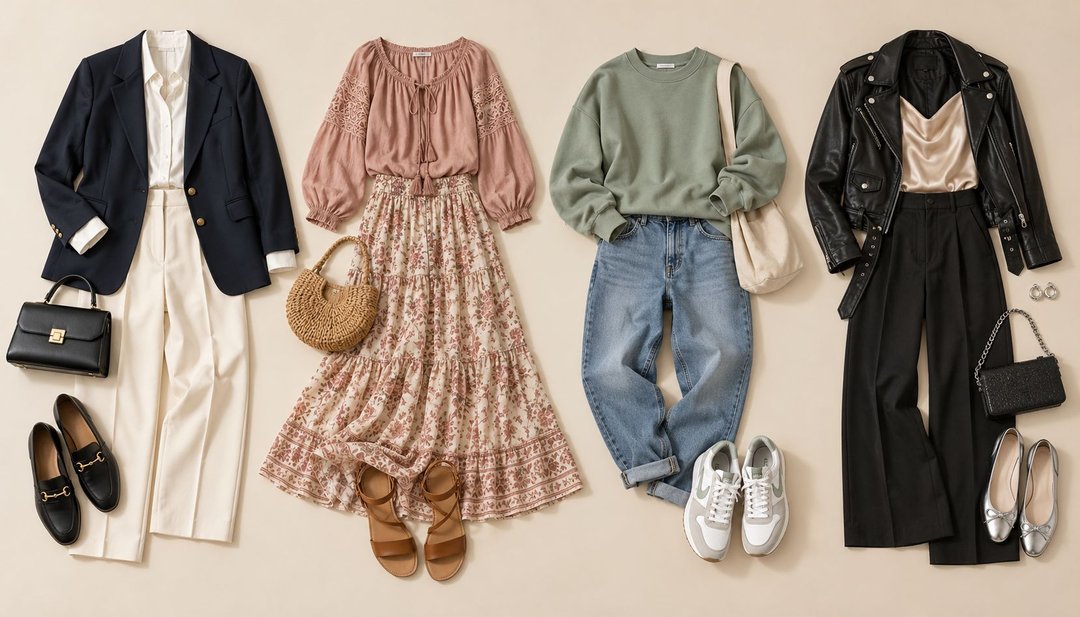
Four outfit comparisons using similar pieces
The following examples illustrate possible changes. They assume the relevant workplace or venue permits the clothing shown.
| Starting point | Smart-casual example | Business-casual example | What changes? |
|---|---|---|---|
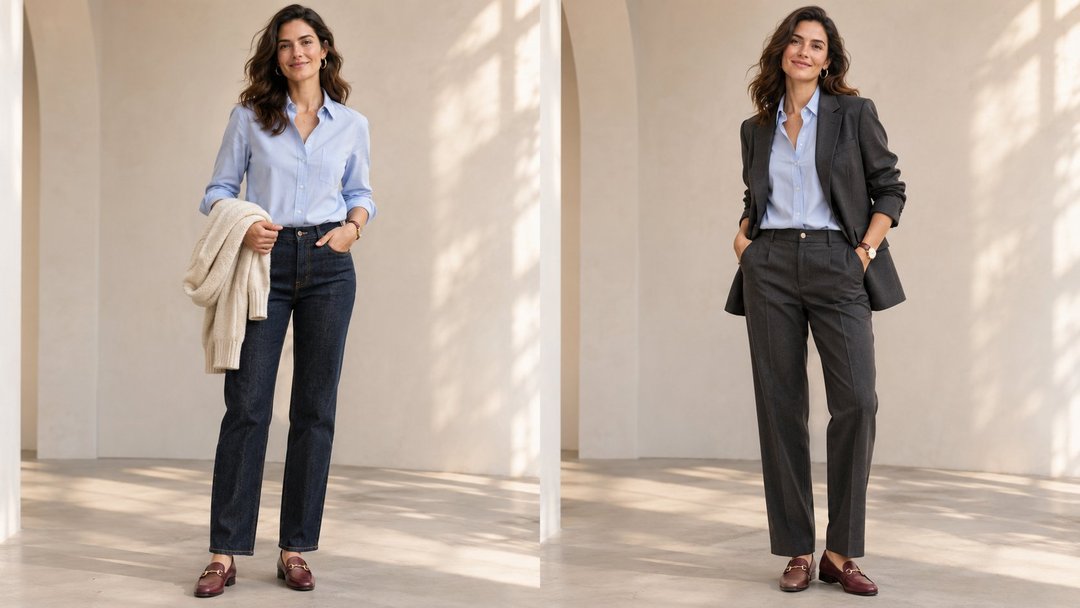
| Blue button-down shirt | Shirt, dark jeans, loafers, and a cardigan | Same shirt, dress pants, loafers, and an optional jacket | Denim becomes dress pants |
| Soft knit top | Knit top, midi skirt, and simple sneakers where allowed | Same top and skirt with workplace-approved flats or boots | Footwear |
| Printed blouse | Blouse, jeans, and ankle boots | Same blouse, tailored pants, and ankle boots | The base becomes more work-focused |
| Simple dress | Dress with a casual jacket and suitable shoes | Same dress with a cardigan or blazer and workplace-approved shoes | The outer layer and finishing details |
The point is to identify the element that needs changing. You may already own the pieces required for both versions.
If the button-down shirt is your starting point, these ways to style a button-down shirt offer additional combinations to test.
Can you wear jeans for smart casual or business casual?
Jeans can work in some settings under either label. They are not automatically accepted under either one.
If denim is permitted, consider the pair itself and the complete outfit. Some policies distinguish between intact jeans and distressed denim, or specify certain colors or finishes.
A darker pair with a blouse and loafers might meet one workplace’s expectations. Another workplace may require dress pants regardless of how the jeans are styled.
Adding a blazer does not override a no-denim policy.
For a new workplace or an unfamiliar event, confirm the guidance before making jeans the foundation of your outfit.
Are sneakers smart casual or business casual?
Sneakers depend on the setting, the pair, and any footwear requirements.
A simple pair may work for a smart-casual dinner or a workplace that accepts sneakers. Another setting may expect different footwear.
Comfort matters, too. You do not need to choose heels to make an outfit feel finished. Flats, loafers, boots, and other options can work when appropriate for the occasion.
If you commute in one pair and change at your destination, include that change in your plan. Otherwise, choose an accepted shoe that works for the whole day.
Do you need a blazer?
Neither label universally requires one.
A blouse and dress pants may be enough for a workplace that describes its dress code as business casual. A dress and cardigan may fit a smart-casual event without a blazer.
Think about what the jacket contributes:
-
Does it meet a stated requirement?
-
Does it add the level of structure you want?
-
Is it comfortable over the chosen top?
-
Will it be practical for the temperature?
If you like traditional tailoring, the classic style guide provides related outfit references. Classic is an aesthetic direction, though; it does not establish the rules for an employer or event.
How to adapt one outfit without starting again
Try this exercise with clothes you already own.
Start with a complete combination
Choose a top, pants or skirt, shoes, and any necessary layer.
For example:
Blue shirt, navy pants, loafers, and a cardigan.
Check it against the occasion
Confirm that each element meets the actual instructions. Include the weather and your plans for the day.
Change one element for the second setting
If your workplace accepts the original outfit but the evening venue allows a more relaxed version, you might change the pants to jeans.
If the evening event asks for something dressier, you might keep the pants and change the top instead.
The useful change depends on the destination. There is no requirement to make an after-work outfit more casual.
Try on both versions
Sit, walk, and check the layers. Photograph the versions you would want to repeat.
For help assembling the combinations, follow the guide to creating outfits from clothes you already own.
Keep your personal style within the dress code
A dress code tells you what is expected in a setting. It does not have to become your entire style identity.
You might prefer a minimalist outfit, a romantic detail, or a preppy combination while meeting the same workplace requirements.
For example:
-
A simple knit and tailored pants can have a minimalist feel.
-
A softly gathered blouse can add a romantic detail.
-
A collared shirt under a sweater can introduce a preppy reference.
Explore the Modesona style guides to compare these directions. Then choose details that you enjoy and that fit the occasion.
If you are still working out your preferences, the guide to finding your personal style offers a process for testing them in everyday outfits.
Frequently asked questions
Is business casual more formal than smart casual?
Often, but not consistently enough to use that as the only rule. Business casual is tied to professional expectations, while smart casual also appears in social settings. Follow the specific workplace or event guidance.
Can the same outfit be both smart casual and business casual?
Yes. A blouse, tailored pants, and loafers could fit both descriptions when accepted by the relevant workplace or host.
Is smart casual appropriate for a job interview?
It can be when the employer specifies it. Do not assume an interview is smart casual simply because the company has a relaxed atmosphere. Ask the recruiter or contact person when the expectations are unclear.
Can business casual include color and prints?
Yes, where the workplace permits them. Neutral colors are an option, not a universal requirement. The print, garment, role, and workplace context all matter.
Do I need separate wardrobes for both dress codes?
Not necessarily. Shirts, knitwear, pants, dresses, and shoes may work across both. Identify the actual difference in requirements before buying additional clothing.
Choose for the setting, then make it yours
Start with the employer’s or host’s instructions. Build a complete outfit, check comfort and practicality, and change only what the occasion requires.
Once those requirements are clear, use your preferred colors, shapes, textures, and details to make the combination feel personal.
Browse the women’s style library to find references you can adapt with the clothes already in your closet.