Shop Your Closet: Rediscover Clothes You Rarely Wear
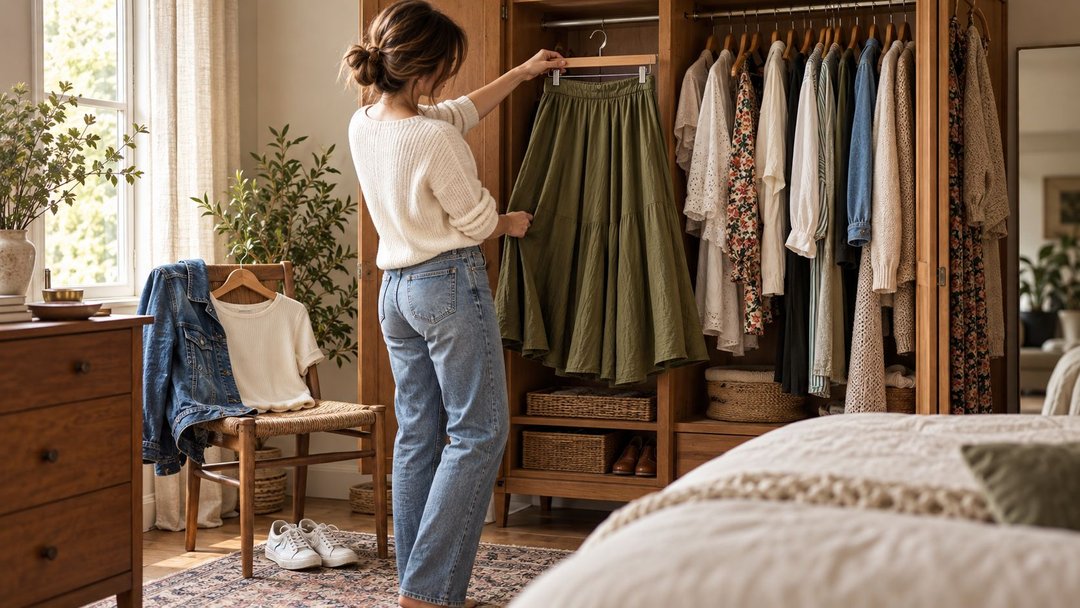
To shop your closet, choose one overlooked piece, work out why you rarely wear it, and test it with clothes you already use. Save a complete outfit that feels comfortable, try it on a suitable day, and decide what to keep or change afterward.
You don’t need to empty your closet, buy coordinating pieces, or make yourself wear something uncomfortable. Start with one item you’re curious about.
The useful result might be a new everyday outfit. It might also be a clear explanation of why a garment needs care, belongs to another season, or no longer suits your preferences.
Here’s how to give rarely worn clothes a fair, practical test.
What does “shop your closet” mean?
Shopping your closet means looking through the clothes you already own for options you have overlooked, rather than starting with something new to buy.
That can include:
-
Wearing a special-occasion piece in a more casual combination.
-
Finding a forgotten top behind your everyday favorites.
-
Pairing work pants with clothes you usually wear on weekends.
-
Preparing a garment you avoid because it always needs ironing.
-
Revisiting something you like but have never made into a complete outfit.
You can do this without a shopping ban or a particular wardrobe size. Repeating favorite outfits is fine, too.
The aim is to find useful options, not to prove that every item deserves frequent wear.
1. Choose one piece you still want to explore
Look for something that interests you now.
Perhaps it’s a printed blouse, a skirt from an event, a colorful sweater, or pants you bought for a different routine. Choose a piece you would like to understand better—not one you feel obligated to justify.
Begin with a small boundary: one drawer, one section of the clothing rail, or a single garment you remember.
Before styling it, check:
-
Is it suitable for the current weather or a realistic upcoming occasion?
-
Is it in wearable condition?
-
Can you try it on comfortably?
-
Do you still like something about it?
If it needs washing or a straightforward repair, record that task. You can continue the exercise with another ready-to-wear item.
If seeing your clothes is the main difficulty, Modesona’s Digital Closet provides a visual catalog with search, filters, favorites, and custom tags. You can also begin with a few photos in a folder.
2. Find out why you don’t wear it
Before changing the outfit, identify what keeps the piece out of your routine.
“I never wear this” describes the result. “I can’t find shoes that work with the hem” gives you something specific to test.
| What happens | A possible obstacle | A useful next step |
|---|---|---|
| You forget the item exists | Visibility | Put it somewhere easy to see or add it to your clothing catalog |
| You like it but cannot picture an outfit | Missing combination | Try it with familiar supporting pieces |
| You reject it every morning because it needs attention | Preparation | Plan the required washing, ironing, or repair |
| It looks appealing but feels uncomfortable | Fit, fabric, or movement | Check the garment itself before trying more styling |
| It belongs to a different season or activity | Timing | Keep it for an appropriate occasion |
| You like the idea of it but not wearing it | Preference | Allow yourself to stop the experiment |
More than one obstacle can apply.
A blouse might be hard to see and need ironing. Moving it to the front of the closet solves only the first problem.
Low wear does not automatically mean a bad purchase
A raincoat, interview outfit, or formal dress can have a useful role without being worn every week.
Ask whether the item meets a need you actually have. An everyday sweater and an occasional outfit do not need the same wearing frequency.
You also don’t have to keep experimenting with a garment that hurts, restricts movement, or requires constant adjustment.
3. Give the piece one real occasion
Choose a specific situation before selecting the rest of the clothes.
For example:
-
A casual office day with time spent sitting.
-
An afternoon of errands and walking.
-
A meal with friends.
-
A relaxed day at home.
-
An event already on your calendar.
This helps separate a styling problem from a mismatch with your schedule.
A delicate blouse may work for a seated dinner but not for gardening. Pants you enjoy standing in may become uncomfortable during a long commute.
Write a short brief:
I want to wear my green skirt for Saturday lunch and a walk. I need comfortable shoes, a suitable layer, and clothes that let me sit easily.
That gives the experiment a clear purpose.
If your wider preferences have changed, finding your personal style can help you distinguish what you enjoy wearing from what you admire in a photo.
4. Pair the overlooked item with familiar clothes
Keep the rest of the first outfit straightforward.
Choose pieces whose comfort and usefulness you already know: your usual jeans, a familiar top, dependable shoes, or a layer you wear regularly.
For example:
| Overlooked piece | Familiar pieces to test with it | What you are checking |
|---|---|---|
| Printed blouse | Everyday jeans and walking sneakers | Whether the blouse works outside a dressier setting |
| Tailored pants | A favorite T-shirt and suitable flats | Whether the pants fit into a casual day |
| Fluid midi skirt | A familiar knit top and comfortable shoes | Movement, waistband comfort, and how the layers sit |
| Bright cardigan | An outfit you already wear | Whether you enjoy the color in an existing combination |
| Occasion dress | A casual jacket and familiar footwear | Whether the dress suits another real activity |
These are experiments, not a shopping list. Use the closest suitable pieces you own.
Include footwear from the beginning. An outfit is still unfinished if you like the clothes but cannot walk comfortably in the shoes.
If the basic assembly is difficult, follow our broader guide to creating outfits from clothes you already own.
5. Try it on and change one thing
Put on the complete outfit.
Sit down, walk, reach forward, and add the outer layer or bag you expect to use. Check coverage, movement, temperature, and any details that bother you.
Then describe the problem before making changes.
Instead of “This looks wrong,” try:
-
“The skirt and top bunch at the waist.”
-
“These shoes don’t work with the pant length.”
-
“The jacket feels restrictive over these sleeves.”
-
“I like the colors, but the outfit feels too formal for my plans.”
-
“I keep adjusting the neckline.”
Change one relevant element and compare.
You might try a different top length, another suitable shoe, a softer layer, or wearing a shirt open rather than buttoned. A tuck is an option only if it feels comfortable and gives you a result you like.
You don’t need to keep testing indefinitely. If the same garment-level problem remains across combinations, more accessories are unlikely to resolve it.
Example: a skirt saved for special occasions
Imagine you own an olive midi skirt that you like but rarely choose.
Your first explanation is that it feels too dressy. You try it with a familiar cream T-shirt and sneakers for an informal lunch.
The outfit feels more relaxed, but the shirt gathers awkwardly at the waistband. You replace it with a shorter top you already wear.
Now you can sit and walk comfortably, and you like the combination.
You photograph the outfit and keep it as a candidate for lunch. Wearing it for the actual outing will tell you more than the try-on alone.
If the waistband remains uncomfortable, the next step is to assess that issue—not keep changing the shoes.
6. Save the complete outfit and the reason it works
Record enough detail to use the combination again.
A photo album or note is sufficient. Include:
-
The exact pieces.
-
Shoes and any necessary layer.
-
The occasion.
-
A useful preparation or comfort note.
For example:
Olive skirt + short cream top + white sneakers + denim jacket. Informal lunch and walking. Check the forecast; skirt needs steaming first.
In Modesona’s Saved Outfits, you can keep complete combinations from your digital closet, mark favorites, and retain useful notes.
If you want suggestions, AI Stylist Chat can use your available wardrobe and the context you provide. Give it a specific request:
Help me style my olive midi skirt for a casual lunch with walking afterward. Use clothes from my digital closet, include comfortable shoes, and don’t add shopping suggestions.
Check the proposed items against your actual clothes. A suggestion does not confirm fabric feel, fit, or comfort.
You don’t need to catalog everything first. Our guide to starting a digital closet with a small selection explains how to begin gradually.
7. Test the outfit on a suitable day
Choose an occasion where the outfit fits your plans and you can make a change if needed.
There is no need to test an uncertain combination during an important presentation or a long journey.
Keep a reliable alternative available while you learn whether the new outfit works for you.
You can assign a saved look to a date using Modesona’s Outfit Calendar, or simply write it in your notes. Check the weather and garment readiness before the day arrives.
After wearing it, record:
-
What stayed comfortable?
-
What needed adjustment?
-
Did it suit the activity?
-
Would you choose it again?
A scheduled outfit shows what you planned. Make a separate note of what you actually wore.
For a repeatable planning routine, see how to plan outfits for the week.
Decide what happens next
The experiment should leave you with a clearer next step.
| Result | Next step |
|---|---|
| You enjoyed wearing the outfit | Save it as a combination to repeat |
| One detail caused a problem | Record one adjustment for another suitable day |
| The piece needs care or repair | Identify the task, likely effort, and whether you want to do it |
| It works only for a particular occasion or season | Keep that role clear |
| It remains uncomfortable or no longer appeals to you | Stop trying to force it into everyday use |
Keeping an occasional piece is a valid decision. So is deciding that something no longer belongs in your active wardrobe.
If you choose to pass an item on, consider its condition and the requirements of the recipient or local service.
Before buying something to make it work
Check whether the obstacle really is a missing item.
Try the suitable alternatives you already own. Then describe the need precisely.
“Something to go with this skirt” is vague. “A comfortable shoe for walking that works with this skirt and two pairs of pants” gives you a more useful comparison.
A new purchase is one possible response. An adjustment, a repair, a different occasion, or setting the garment aside may be another.
A worksheet for clothes you rarely wear
Use one row per item.
| Item | Why I rarely wear it | First outfit to test | Preparation needed | What happened when worn | Next step |
|---|---|---|---|---|---|
| Olive midi skirt | Feels too dressy for normal days | Short cream top, sneakers, denim jacket | Steam according to care label | Comfortable for lunch and walking | Save and repeat |
| Printed shirt | Hidden behind work clothes | Familiar jeans and everyday shoes | Check forecast | Not tested yet | Choose a suitable day |
| Tailored pants | Waistband uncomfortable when sitting | No further outfit test yet | Assess the fit issue | — | Decide whether alteration is worthwhile |
The examples are illustrative. You don’t need to finish several items or reach a target number of outfits.
One combination you want to wear again is a useful result.
Don’t confuse wardrobe data with wear history
A clothing catalog helps you see what you have recorded. It does not automatically establish what you wear.
For example, Modesona’s Wardrobe Statistics describes the composition of your saved closet, including categories, colors, styles, and seasons. Those breakdowns do not by themselves identify the clothes you wear least.
Use your own observations or a wear log when deciding which pieces to revisit. An incomplete catalog also leaves out anything you haven’t added.
The question is whether a piece could serve you better—not whether your closet meets a particular chart or score.
Frequently asked questions
How do I start shopping my closet?
Choose one piece you still like but rarely wear. Identify the reason, select a real occasion, and try it with familiar clothes and suitable shoes. Save a complete outfit, wear it when appropriate, and review the result.
Do I need to clean out my whole closet first?
No. Start with one item or a small section. A full cleanout is a separate task and is not required to test a new combination.
What if I wear the same clothes all the time?
Repeating comfortable outfits is fine. If you want more options, introduce one overlooked piece into a familiar combination. Keep the rest dependable while you assess the change.
Should I get rid of clothes I haven’t worn recently?
Not automatically. Season, occasion, preparation, comfort, and changing routines can explain low use. Decide whether the item still has a role before treating time unworn as the only measure.
Can I shop my closet without an app?
Yes. Use the physical clothes, a mirror, a phone photo, and a short note. An app is optional and can help you find pieces or keep successful combinations together.
What if none of the outfits work?
Name the obstacle. It may be fit, fabric, condition, an unsuitable occasion, or a preference that has changed. You can stop the experiment without buying more clothes to justify the item.
Give one overlooked piece a useful test
Choose something you still want to explore. Find out why it stays unworn, try it with familiar clothes, and save one complete combination.
Then wear it on a suitable day and use that experience to decide what comes next.
To keep the result easy to find, save the combination in Modesona’s Saved Outfits. Your next useful outfit may already be in your closet.