Fabrics
- corduroy
- rigid denim
- rayon
- suede
- tweed
- velvet
→ 01 / Men
Past decades, worn today
Style that revives specific eras — 70s flares, 80s shoulders, 90s slips or Y2K — with true vintage pieces or modern reissues.
The short answer
Retro style for men is one era, accurately cut: 70s flares, wide collars and corduroy; 50s bowling shirts and rigid denim; 90s loose fits and heritage sneakers. Vintage does the heavy lifting and plain modern pieces support it. Get the collar point and the trouser rise right and very little else has to be old.
One decade per outfit. Two is not retro, it's a costume box.
Updated September 22, 2026
→ 02 / What defines it
→ 03 / Where it comes from
Wearing old clothes on purpose is newer than it sounds. For most of the twentieth century secondhand meant necessity, and then in the 1960s young people in London and New York began buying thrift-store 1930s dresses and army surplus precisely because they were not new — and the shops serving them, Biba and the Portobello stalls among them, turned that into a style you could buy into. Every revival since has run on roughly the same clock: an era comes back once the people who lived through it stop being embarrassed by it, which takes somewhere around twenty to thirty years. That is the rockabilly 1950s revived in the 1980s, the 1970s in the 1990s, the 1990s in the 2010s, and Y2K now that resale apps have made the originals easy to find. What separates retro from fancy dress is accuracy: the rise of the trouser, the point of the collar, the width of the lapel. Get the cut right and a single garment will date the whole outfit for you.
→ 04 / Retro outfit ideas
Year-round
Why it works: The collar and the flare have to agree in scale. A genuine 70s shirt collar over a slim modern leg reads as a costume top worn with normal trousers, which is the most common error here.
Warm
Why it works: Rayon drapes in a way cotton doesn't, which is most of why original bowling shirts look right and reproductions often don't. Cuff the denim once, wide and flat, rather than rolling it repeatedly.
Year-round
Why it works: The 90s is a proportion rather than a print: wide leg, boxy top, nothing tapered anywhere. It is the easiest era in this wardrobe to wear if flares are never going to be for you.
Cool
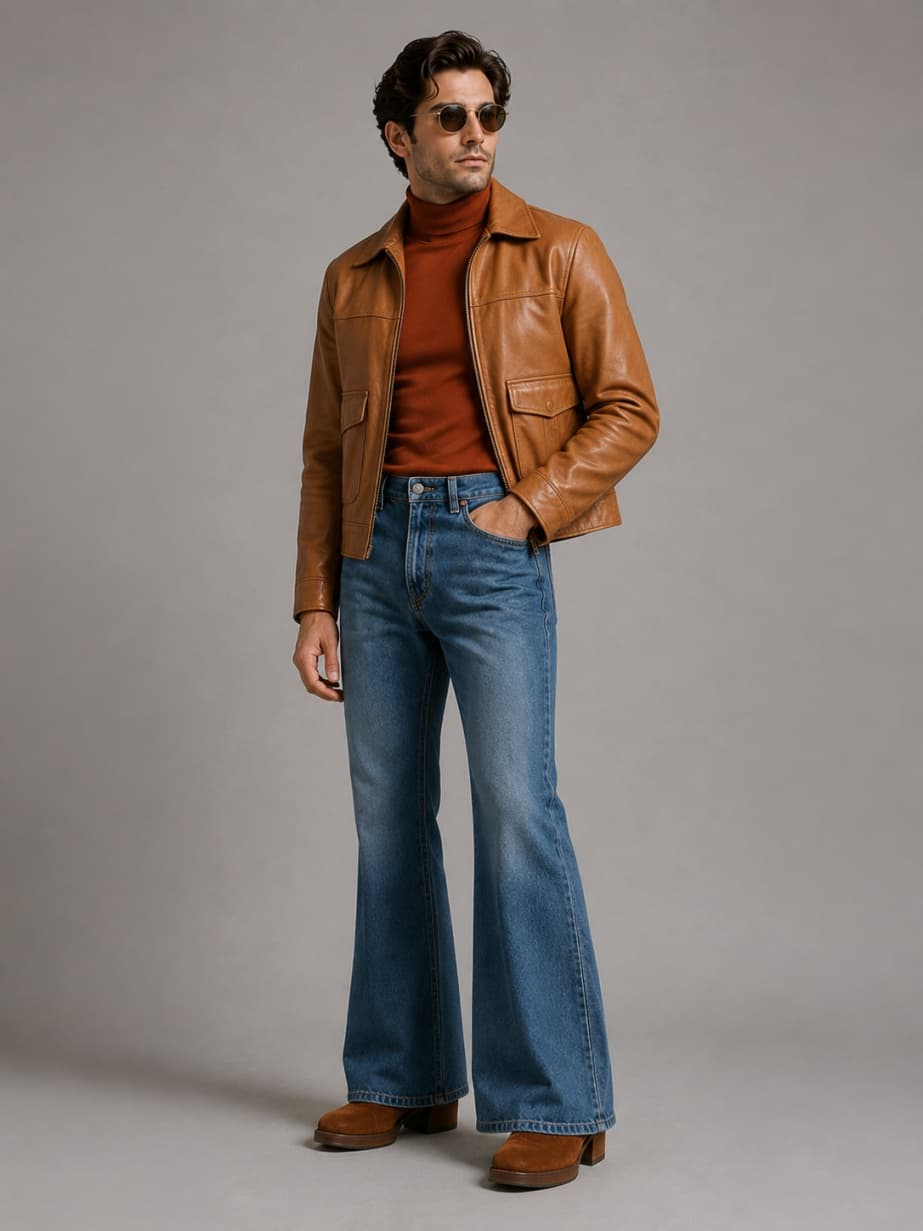
Why it works: One old jacket over an otherwise contemporary outfit is the most wearable version of retro, and outerwear is where forty-year-old construction shows most clearly against anything new.
Cold
Why it works: Old coats used more cloth and heavier linings than most new ones at the same price. This is the single vintage purchase that does the most work per dollar in the whole wardrobe.
Year-round
Why it works: Lapel width, trouser flare and heel height all have to come from the same decade. A wide lapel over a modern slim trouser is the most common failure in vintage tailoring.
→ 05 / Outfit examples
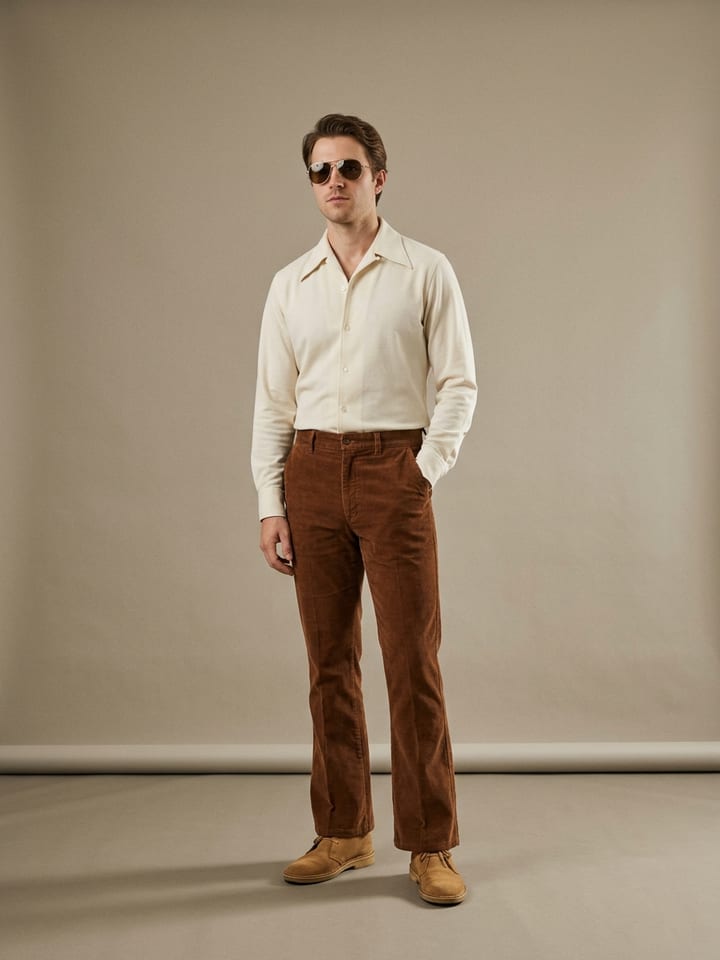
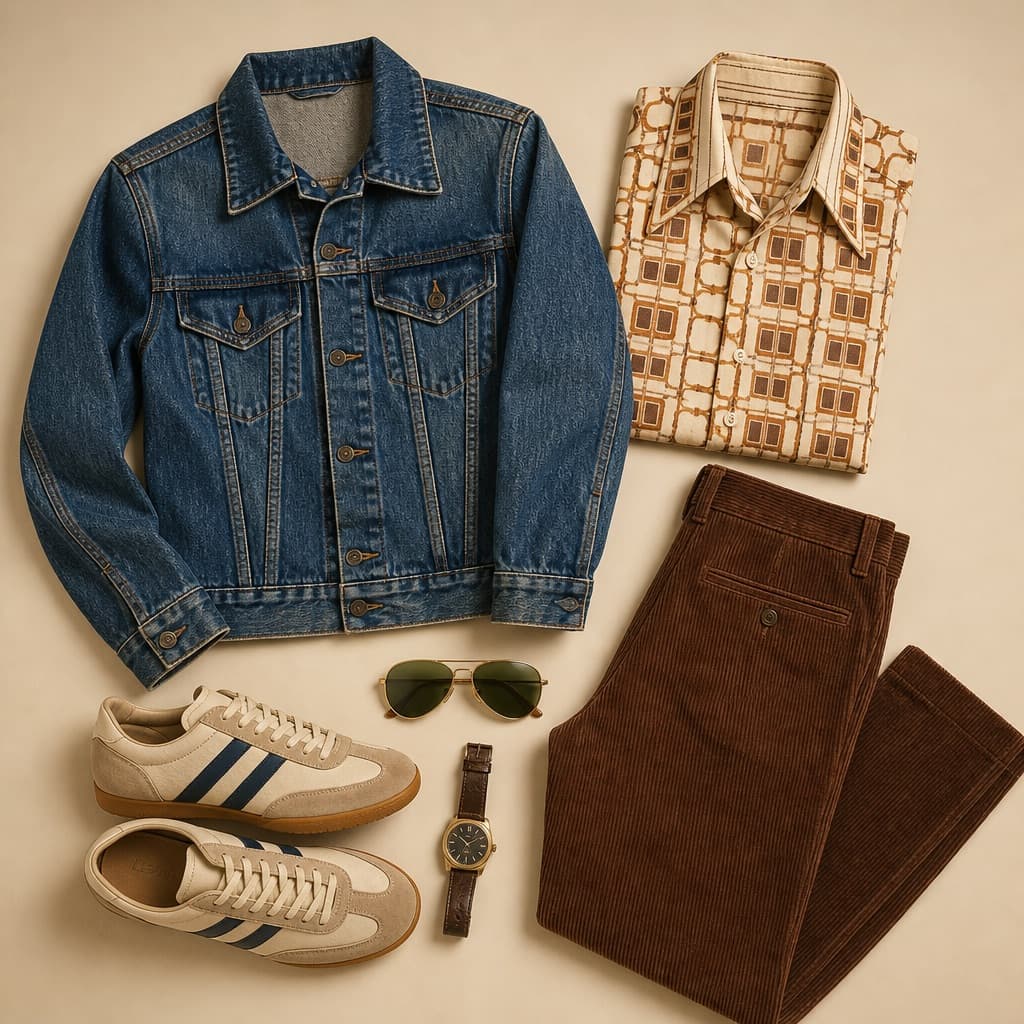
Corduroy flares with a wide-collar shirt and desert boots.
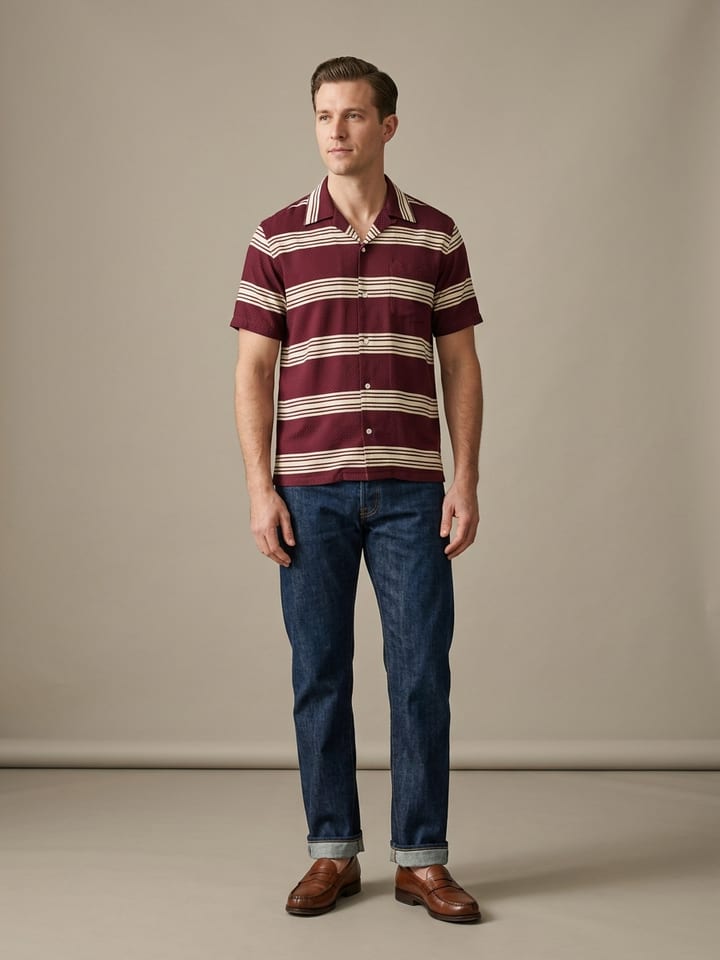
A rayon bowling shirt with rigid denim, cuffed once.
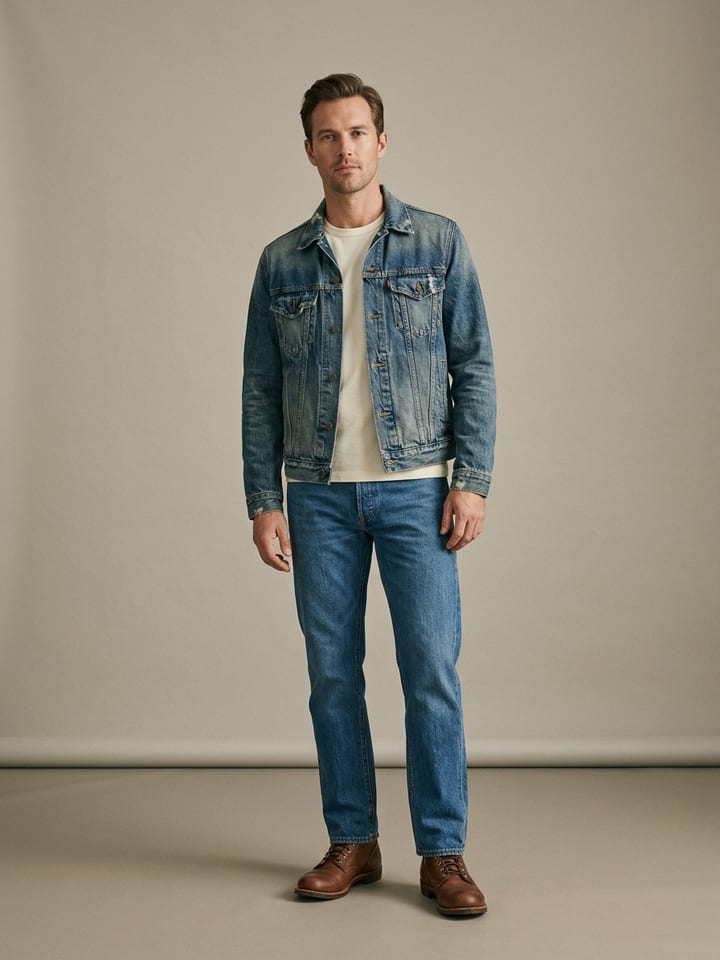
An old denim jacket over a plain tee and straight jeans.
→ 06 / Key pieces · Men
→ 07 / Starter capsule
→ 08 / Palette & fabrics
Modern performance colors — high-visibility accents, cool greys, anything that looks technical. No contemporary athletic footwear either: a cushioned running shoe under vintage trousers undoes the outfit in a single glance. Slim fit is the other killer, because none of these decades were cut close to the body.
→ 09 / Across the seasons
50s territory: loop-collar shirts, rigid denim, canvas sneakers. Light, plain and the least research-heavy corner of the style.
Rayon and short sleeves, or 90s loose cotton. Keep the shoe period-correct — this is the season modern sneakers creep back in unnoticed.
Corduroy, suede and 70s knitwear in brown and mustard. The richest season for the style and the best one for thrifting.
A vintage overcoat over a roll-neck and cord trousers. Old outerwear beats new outerwear at this price point almost every time.
→ 10 / Where it goes wrong
Mixing eras. A 70s shirt with 90s baggy jeans and current sneakers is three decades in one outfit and no point of view at all.
Instead: One era per outfit, and when you are unsure, put the vintage piece with plain contemporary basics instead of with other vintage.
The wrong shoe. This is where most men's retro dies — heritage models and leather work, modern runners and chunky trainers don't.
Instead: Match the shoe to the decade: loafers or canvas for the 50s, suede and stacked heels for the 70s, heritage runners for the 90s.
Ignoring the rise. Vintage trousers sat at or near the natural waist, and wearing them down on the hip ruins the proportion and the length at the same time.
Instead: Wear them where they were cut to sit, then get the hem adjusted for that position rather than for where your jeans normally sit.
Reissues only. A wardrobe made entirely of modern heritage versions ends up looking uniformly new, which is the opposite of the intended effect.
Instead: Own at least one genuinely old piece per outfit. Reissues work well as the supporting cast and badly as the lead.
→ 11 / How to start this week
→ 12 / Style icons, and what they actually wore
Silk shirts, 70s collars, gold chains and Cuban heels, held to one era per look. Commercial proof that full-commitment retro reads as charisma rather than costume.
High-water trousers, bowling shirts and 70s knitwear in colors lifted off old paint charts. He mines specific decades for silhouette and then rebuilds the palette himself.
Corduroy suits, thrifted knitwear and heavy 70s frames, worn continuously since the early 90s. The template for retro as a permanent wardrobe rather than a reference.
→ 13 / This might be you if...
→ 14 / Often confused with
→ 15 / Mixes well with
→ 16 / FAQ
Retro style for men revives a specific decade: a 70s collar, heritage sneakers, corduroy, a vintage denim jacket — not “old clothes” in general.
Do commit to one era’s details. Do make a vintage piece the core. Do keep the rest wearable so it is style, not a skit.
Don’t mix 60s, 80s, and Y2K in one look unless you know why. Don’t rely on cheap Halloween versions of the decade. Don’t ignore the shoulder and the rise.
Men can wear Retro style daily, to gigs, and in creative work. Extreme period dressing is for events; offices may want a quieter decade cue.
Typical colors for men’s Retro style follow the decade, in denim, corduroy, and leather. Match the palette to the era, not to this season’s trend report.
A common Retro mistake for men is looking costumed — a full 70s suit with novelty glasses — or wearing “vintage wash” fast fashion with no actual cut. The cut is the tell.
Two minutes of swiping tells you whether Retro is genuinely your Style DNA — or a thrifting habit that hasn't become a wardrobe yet.
Take the style quizYou are cordially invited
Modesona is your personal stylist — free, instant, and built around everything already hanging in your wardrobe.


Free · No card required · iOS & Android