Closet Cleanout: How to Decide What Clothes to Keep

Your drawer is difficult to close. A favorite shirt is hidden behind clothes waiting for repairs. You keep moving the same uncertain pieces from one shelf to another.
A closet cleanout can help you make those decisions and leave your clothes easier to find.
To clean out your closet, choose one manageable section, check each item’s condition, comfort, and purpose, then decide whether to keep it available, prepare or repair it, store it separately, or pass it on. Give uncertain items a specific next step and finish by putting everything in its intended place.
You can work through one drawer, your work pants, or a short section of the clothing rail. The useful result is a finished area and a clear plan for anything still pending.
Here’s a step-by-step closet cleanout checklist, followed by a ten-item example.
1. Choose a section you can finish
Give the session a clear boundary before taking clothes out.
Try one of these:
-
Everyday T-shirts.
-
Pants you wear to work.
-
One drawer.
-
Shoes for the current season.
-
The items on one section of your clothing rail.
Choose a group you can assess, return, and tidy within the time and energy you have.
Leave time at the end for putting clothes away and recording outstanding tasks. If you have a short session, choose fewer items rather than leave a larger pile unfinished.
You’ll need a clear surface, somewhere to place each decision group, and a note for repairs or follow-up. Use containers you already have.
For a shared closet, keep the session within your own clothes unless the other person is participating.
Define what you want to improve
Write one practical outcome:
I want to find my work pants easily and know which pairs are ready to wear.
Or:
I want this drawer to close comfortably, with everyday tops visible.
That outcome helps you judge whether your decisions are useful. It also gives you a stopping point.
2. Separate preparation problems from decisions about keeping clothes
Before deciding that something has no place in your wardrobe, check what is preventing you from using it.
A shirt waiting for ironing, pants with a loose hem, and a sweater you dislike wearing have different problems.
| What you notice | What to investigate |
|---|---|
| You regularly wear it and it is ready | Where it belongs in your active wardrobe |
| It needs washing, drying, or ironing | The specific preparation required |
| A fastening, seam, or hem needs attention | Whether a repair is realistic and worthwhile to you |
| It suits another season or occasional activity | An appropriate place to keep it |
| You like it but never choose it | The reason it remains unused |
| It stays uncomfortable | Whether the garment itself meets your needs |
Follow the care label when preparing clothes. A laundry task can be recorded without turning the session into a day of washing.
If an item is usable but the missing piece is a combination, set aside a small outfit experiment. Our shop-your-closet guide explains how to test an overlooked garment with familiar clothes.
Keep that experiment bounded so it does not interrupt the whole cleanout.
3. Ask what each item does in your life
Use the same questions for the clothes in your chosen section:
-
Is it comfortable to wear now? Consider sitting, movement, fabric feel, and the coverage you want.
-
What would I use it for? Think about your actual work, home life, activities, climate, and occasions.
-
Do I want to wear it? Separate your preference from guilt about the purchase.
-
What condition is it in? Identify any care, repair, or alteration needed.
-
What happens next? Give it a place or a concrete action.
You do not need a convincing answer for every day of the week. An interview outfit or rain jacket can serve a valuable purpose occasionally.
Likewise, an expensive item does not need to stay in your everyday selection simply because you paid for it.
If your routine or preferences have changed, the guide to finding your personal style can help you describe what you enjoy wearing now.
Use this clothing decision guide
| Decision | When it may fit | Finish with |
|---|---|---|
| Keep available | Comfortable, useful clothing you want access to | Return it to a recognizable place |
| Prepare or repair | You want to use it after a specific task | Record the task and next action |
| Store separately | Seasonal, occasional, or sentimental clothing you choose to keep | Give it a suitable, labeled location |
| Review after a test | One unanswered question prevents a decision | Define the test and a sensible review point |
| Pass on | Usable clothing you no longer want or need | Choose a recipient, sale, or accepted donation route |
| Assess another disposal route | The item is unsuitable for ordinary reuse | Check available repair, reuse, or local collection options |
These are decisions for the exercise. They do not need to become permanent labels for your entire wardrobe.
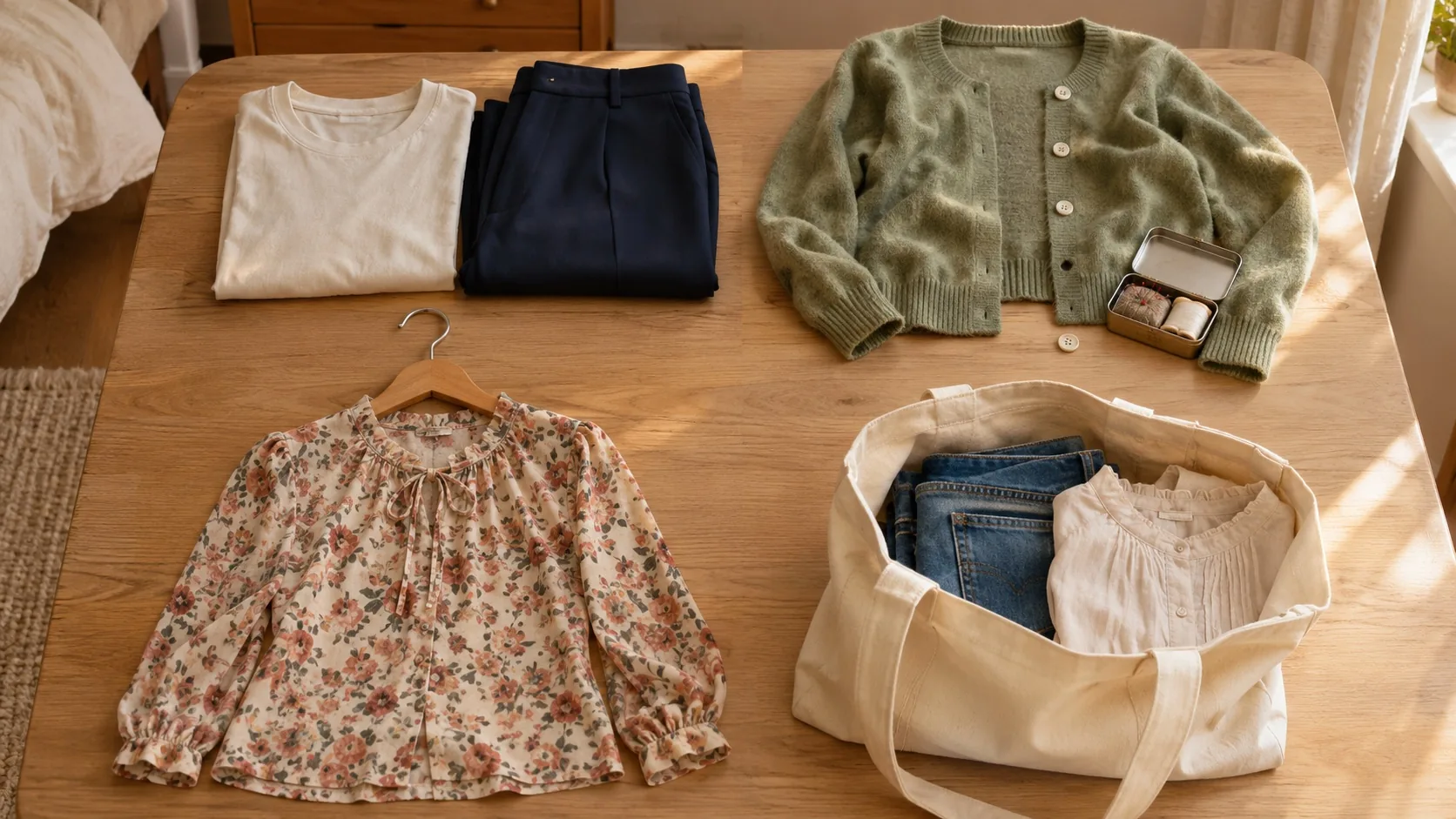
Top row: clothes to keep and a cardigan to repair. Bottom row: a blouse to review and clothes to pass on. AI-generated illustration.
4. Try on the items that need a comfort check
Clothes you already wear comfortably may need little examination. Spend your try-on time where it will answer a question.
For pants, sit down and walk. For a jacket, move your arms with the layer you expect to wear underneath. For shoes, consider your actual routes and any discomfort you already know about.
If you are testing an outfit, include its shoes and necessary layers.
Name the issue precisely:
-
The waistband presses when I sit.
-
The sleeve restricts movement.
-
The fabric feels uncomfortable against my skin.
-
The hem catches under these shoes.
-
I like the piece, but have no current occasion for it.
Different observations lead to different decisions. Another top may help a combination; it will not necessarily solve an uncomfortable waistband.
For help with the combination itself, use the separate guide to creating outfits from clothes you already own.
You can stop a try-on when you have enough information. You do not have to prove that every garment can work.
5. Compare similar pieces before removing duplicates
Put similar clothes beside one another.
Two cream T-shirts may look interchangeable but have different jobs. One might work under a shirt, while the other is comfortable on its own. You may also need both between laundry sessions.
For each similar item, ask:
-
Does it have a different use, fabric, fit, or season?
-
Do I need this amount of fresh clothing between washes?
-
Would removing it leave a recurring situation uncovered?
-
Do I consistently choose another piece instead?
-
Is its only purpose to serve as a backup I never realistically need?
There is no universal number of shirts, pants, or shoes to keep.
A uniform, frequent clothing changes, limited laundry access, or several climates can all affect your requirements. Keep enough for the life you are dressing for.
If you later want a smaller everyday selection within your wider wardrobe, follow the guide to building a capsule wardrobe with clothes you own.
6. Give repairs and uncertain pieces a next action
A repair pile becomes useful when you know what will happen to it.
For each item, record:
-
The problem.
-
The next action.
-
Who will do it.
-
When you will make the decision or complete the task.
For example:
Green cardigan: missing button. Check for the spare button and decide whether to sew it on this weekend.
Or:
Navy pants: hem needs adjustment. Ask an alterations service what the work involves before deciding.
Consider the effort, cost, and your desire to wear the finished item. A garment needing a repair does not automatically belong in either the keep or pass-on group.
Turn “maybe” into a question you can answer
Avoid leaving an item with only the label “unsure.”
Instead, write:
Printed blouse: try with my everyday jeans and comfortable shoes for a casual meal.
Choose a review point connected to that test. If the question concerns winter clothing, a review after suitable weather may be more useful than an arbitrary short deadline.
Sentimental pieces can have their own decision. You may choose to keep a garment for its meaning, with a place separate from everyday clothes. Wearing it regularly is not the only reason to own it.
7. Complete the route for clothes you are passing on
Choose what happens next before placing unwanted clothes into a bag.
Give to someone who wants the item
Check whether the person wants it and whether its condition suits their needs.
Sell
Consider the work involved: photographs, descriptions, messages, packaging, and arranging the handover.
Set a manageable plan. If selling becomes a long-term storage project, reconsider the route.
Donate
Check the receiving organization’s current instructions, including accepted items, condition, and drop-off arrangements.
Do not assume a general clothing donation accepts damaged garments.
Explore repair, reuse, or textile collection
Check what the specific service accepts and whether it operates in your area.
A textile collection point may have different requirements from a clothing donation. Follow its instructions rather than placing an item into an unsuitable stream.
Keep undecided clothing separate from bags already designated for a destination. A clear label helps prevent an accidental handover.
8. Put the keepers back and update your clothing record
Return the clothes you are keeping in a way that supports how you find them.
You might group work pants together, put everyday tops within reach, or keep occasional clothing in a clearly identified section.
Choose storage suited to the garments and available space. You can decide whether you need an organizer after seeing what the section must hold.
Keep the digital closet aligned with your decisions
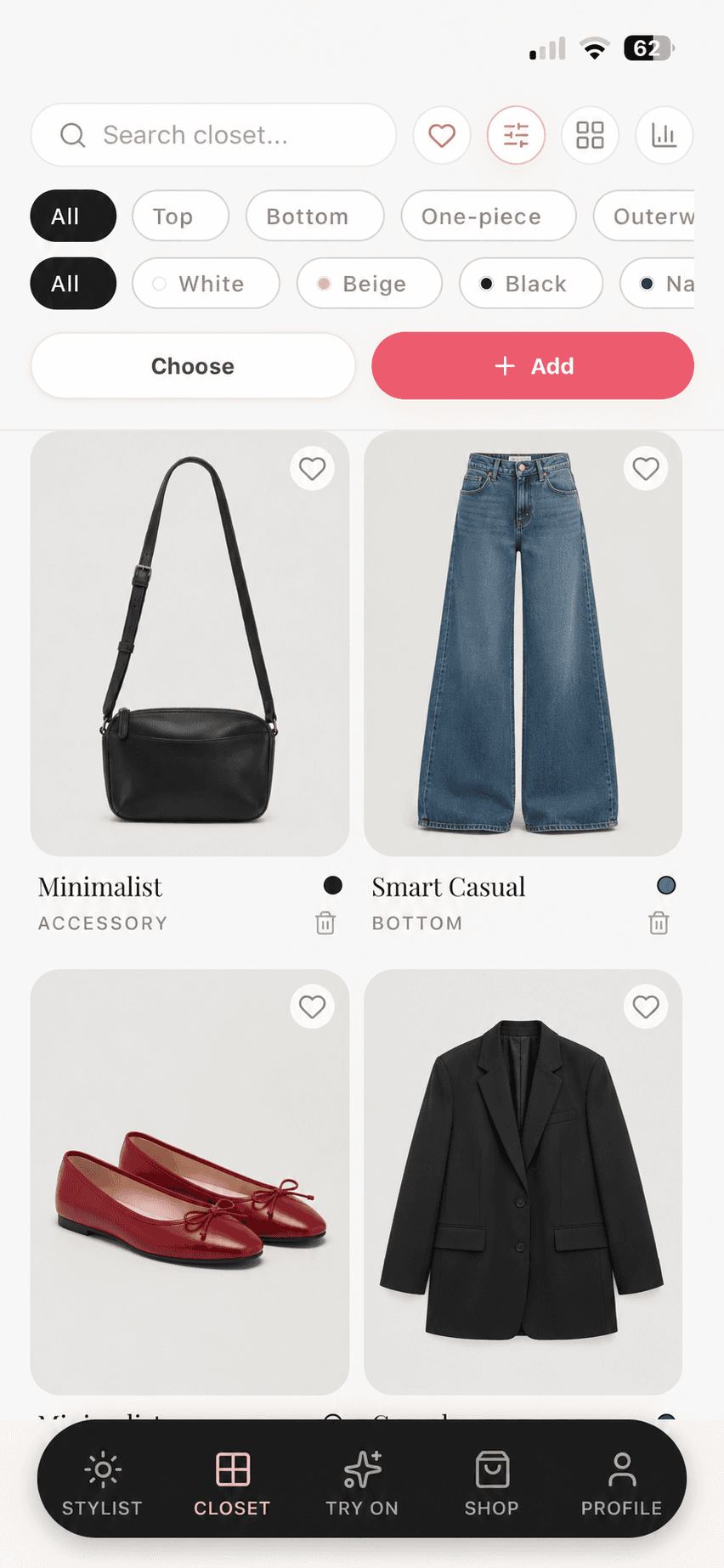
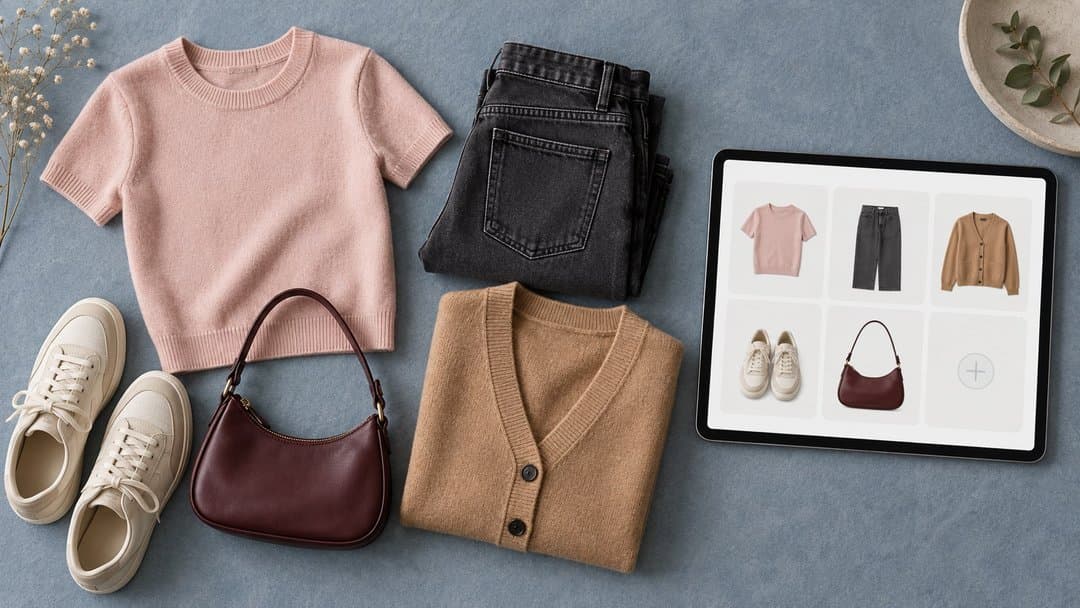
In Modesona’s Digital Closet, you can add, edit, and remove pieces, then find them through search, filters, favorites, and custom tags.
For the category you have just reviewed:
-
Add useful pieces that are missing from the catalog.
-
Correct item details that no longer match.
-
Use a custom tag when it helps distinguish a selection or temporary situation.
-
Remove entries for clothes you no longer own.
Keep repair and storage decisions clear. A garment in another season’s box is still yours; a photograph in the catalog does not confirm that an item is clean, repaired, or ready to wear.
Removing a closet item can affect saved outfits that use it. Review those combinations when updating the record.
If you are starting your catalog, the guide to creating a digital closet gradually explains how to begin with a manageable selection.
Use wardrobe statistics to ask better questions
Modesona’s Wardrobe Statistics shows the composition of your saved closet by details such as category, color, style, and season.
Those breakdowns might prompt a useful question:
I have recorded several similar tops. Do they serve different purposes?
They do not establish which garments you wear most, which feel comfortable, or what you should remove.
An incomplete catalog also produces an incomplete picture. Use the actual clothes and your experience alongside the numbers.
A ten-item closet cleanout example
Imagine you are reviewing a small section containing everyday clothes and a few occasional pieces.
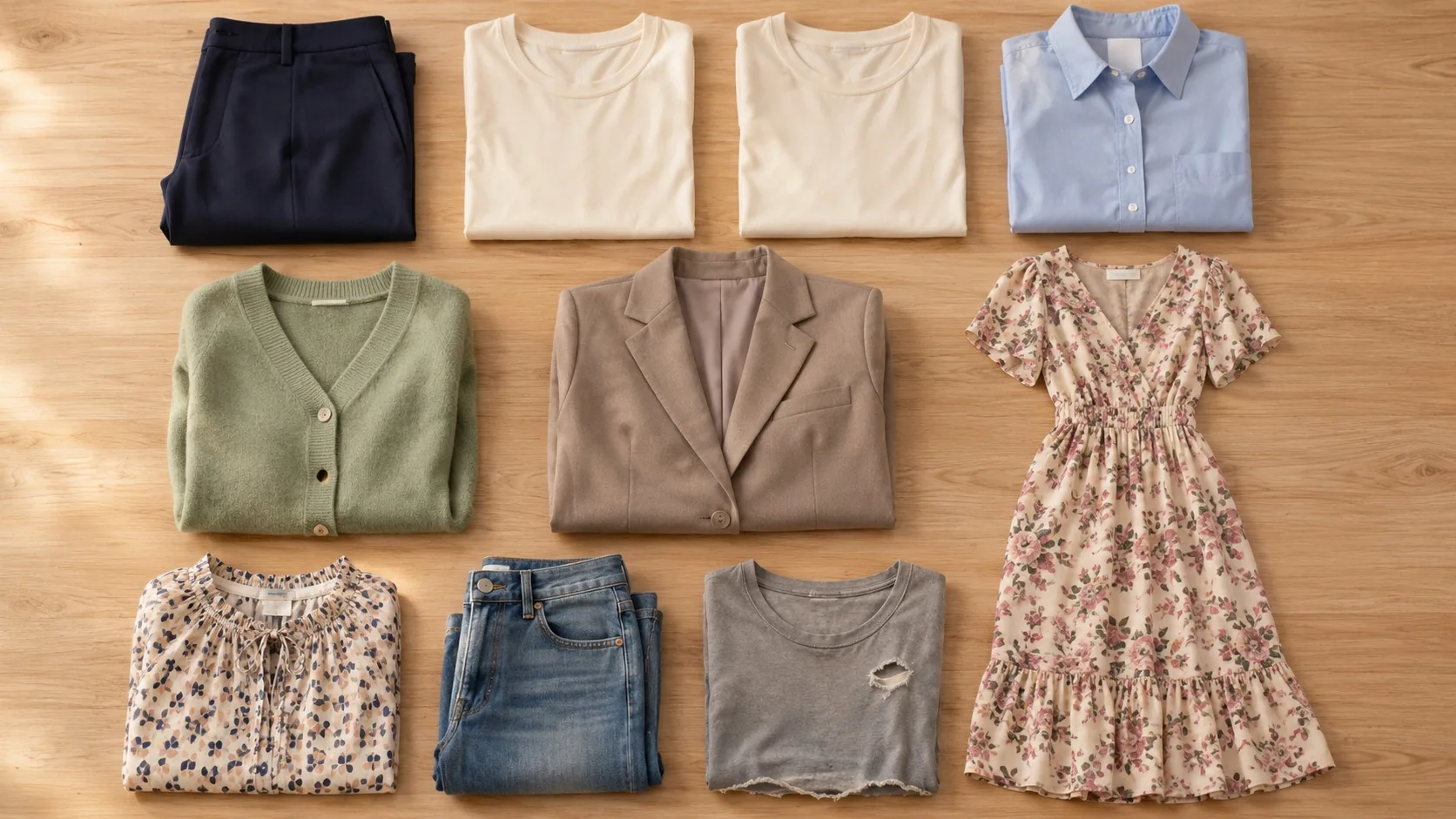
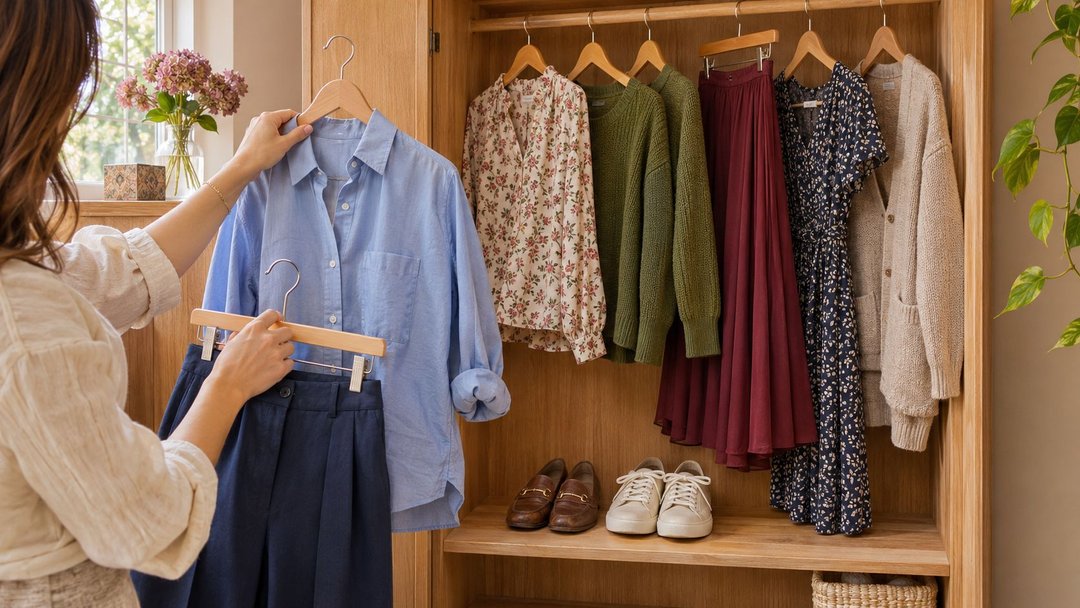
Ten pieces to review individually. Two similar T-shirts may both be useful; a missing button and worn fabric call for different decisions. AI-generated illustration.
| Item | Observation | Decision and next action |
|---|---|---|
| Navy pants | Comfortable and used for work | Keep available with other work pants |
| Cream T-shirt | A regular everyday choice | Keep available |
| Second cream T-shirt | Provides a needed clean change between washes | Keep available |
| Blue shirt | Useful, but waiting for care | Follow the care label and return when ready |
| Green cardigan | Wanted, with one missing button | Check for the spare button and arrange the repair |
| Formal jacket | Useful for occasional events | Keep in an identified occasional-wear section |
| Sentimental dress | Kept for its meaning | Choose a suitable keepsake location |
| Printed blouse | Appealing, but its everyday role is unclear | Try one defined outfit and review the result |
| Uncomfortable jeans | Usable, but you no longer want to wear them | Choose a suitable pass-on route |
| Worn-out top | Unsuitable for an ordinary clothing donation | Check repair, reuse, or an accepted local collection route |
The section is finished when the available clothes are back, the retained items have a location, and the pending actions are written down.
The number removed is not the measure of success.
Your closet cleanout checklist
Before starting another section, check:
-
I finished the section I chose.
-
I considered comfort, condition, purpose, and preference.
-
I kept enough clothing for my activities and laundry routine.
-
Repairs and preparation tasks have a next action.
-
Uncertain pieces have a question or test to resolve.
-
Seasonal, occasional, and sentimental items have a location.
-
Clothes being passed on have an appropriate destination.
-
The active clothes are back where I can find them.
-
I updated the relevant digital records.
-
I can use the space without moving unfinished piles elsewhere.
Frequently asked questions
Do I need to empty my entire closet?
No. You can clean out one category or section at a time. Choose a group you can assess and put away before stopping, then continue with another area when useful.
How many clothes should I keep?
Keep enough for your actual activities, climate, changing preferences, and laundry access. Review similar pieces and their roles before deciding. There is no required wardrobe total.
Should I get rid of clothes I haven’t worn in a year?
Time unworn is a reason to investigate. It does not explain the whole situation. Seasonal clothing, formal outfits, uniforms, and specialist pieces may have a useful role despite infrequent wear.
What should I do with sentimental clothes?
You can keep them deliberately, with a suitable place separate from everyday clothing if that helps. A closet cleanout does not require making every emotional decision in one session.
Can I donate damaged clothes?
Only when the organization explicitly accepts that type and condition of item. Check its current instructions. Otherwise, investigate repair, reuse, or an accepted local collection route.
Do I need a wardrobe app for a closet cleanout?
No. Your clothes, a clear surface, and a short action list are enough to begin. A digital closet can help you keep an accurate visual record and find the clothes you retain.
Finish one section, then decide what comes next
Choose a manageable group of clothes. Check what each item does for you, make a decision, and complete the next action.
You may finish with more room, a repair booked, a forgotten piece ready to test, or simply a clearer understanding of what belongs where.
Start with one category in Modesona’s Digital Closet if a visual record would help. Keep the record accurate, and let the useful decisions guide the next section.